

Counting in a World Governed by Noise
It’s Not the Head
There is a persistent temptation, when confronted with violence, corruption, or cruelty, to focus on faces. Names. Leaders. Criminals. Presidents. Kingpins. The story almost writes itself: identify the villain, remove him, and expect the system to breathe again.
This temptation is understandable — and almost always wrong.
I do not deny the existence of evil. On the contrary, much of what we are witnessing today, from political theater to organized crime, is genuinely evil in its consequences and often in its intent. But insisting on the evilness of individuals as the central explanation misses something more uncomfortable: their behavior is not the disease, but a symptom.
We keep cutting off heads and acting surprised when nothing improves.
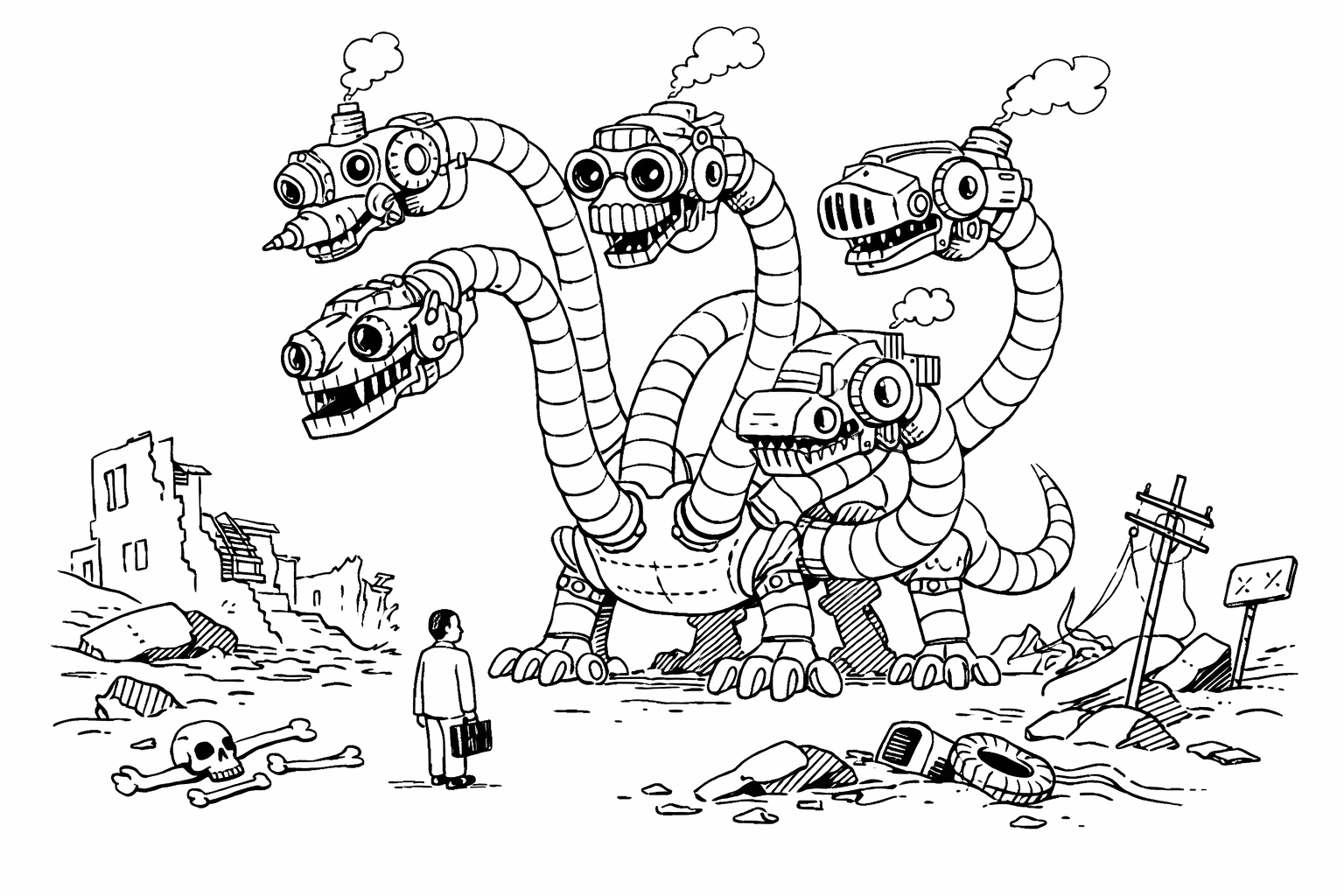
The metaphor that comes to mind is not a hierarchy but a hydra. Eliminate one head and two emerge — not because the creature is supernatural, but because the organism itself remains intact. The mistake is assuming the problem resides in leadership rather than structure, in morality rather than incentives, in bad actors rather than the conditions that reliably produce them.
This is not a defense of politicians or criminals. It is a refusal to mistake diagnosis for absolution.
Evil as an Output, Not an Input
Calling an action evil can be morally correct and analytically useless at the same time.
When extortion flourishes, when young men disappear into violent economies, when institutions rot from within, labeling the actors as corrupt or monstrous offers emotional clarity but little explanatory power. The real question is not why are these people bad? but why does this system keep rewarding the same behaviors regardless of who occupies the role?
If replacing one politician with another changes nothing, perhaps the problem is not the politician.
If dismantling one criminal organization merely fragments violence into smaller, more chaotic forms, perhaps the problem is not the cartel.
We have seen this logic fail repeatedly: the “kingpin strategy,” the obsession with arrests, the belief that moral condemnation plus force equals resolution. It rarely does. Violence mutates. Power reconfigures. The underlying dynamics persist.
Hydras do not die of decapitation.
Systems That Eat Their Operators
One of the most unsettling realizations — and one most political discourse avoids — is that systems often shape people more than people shape systems.
In environments marked by weak institutions, low trust, and unstable enforcement, certain behaviors become not only predictable but rational:
- Nepotism becomes safer than merit.
- Loyalty becomes more valuable than competence.
- Violence becomes a career path.
- Narrative becomes more powerful than truth.
- Short-term extraction beats long-term stewardship.
None of this requires ideological conspiracy. It emerges naturally when incentives align that way.
This is why similar patterns repeat across parties, administrations, and even opposing moral narratives. The surface language changes; the outcomes do not. Different slogans, same results. Different villains, same graves.
Blaming individuals for this is emotionally satisfying but structurally naïve.
Why Counting Still Matters
The danger of focusing exclusively on evil actors is that it quietly absolves the system that keeps generating them. It allows us to believe that once this president is gone, or that criminal is jailed, the problem will resolve itself. History offers little support for this belief.
What actually threatens such systems is not outrage, nor spectacle, nor moral theater — but accounting. Counting bodies. Counting incentives. Counting consequences. Tracing feedback loops. Asking what happens after the head is cut off.
This is slower work. Less dramatic. Harder to weaponize politically.
But it is the only work that treats the hydra as a body rather than a face.
Disposable Men and Replaceable Bodies
Any serious attempt to understand endemic violence has to begin with an uncomfortable fact: the overwhelming majority of the dead are young men, and society has quietly decided that this is acceptable.
Not explicitly, not proudly — but structurally.
They are overrepresented among the unemployed, the undereducated, the incarcerated, the disappeared, and the murdered. When they die, the language used to describe them is revealing: “andar en malos pasos,” “ajuste de cuentas,” “algo debían.” Even innocence, when acknowledged, is framed as tragic but inevitable, like bad weather.
This is what male disposability looks like when it becomes normalized.
In such conditions, violence does not merely recruit — it offers meaning. It provides hierarchy, recognition, rules, belonging. It transforms excess human energy into something legible. When legal society has no use for you, illegal society almost always does.
None of this absolves violence. It explains its efficiency.
A system that produces millions of surplus men should not be surprised when some of them organize themselves around force. The mystery is not why criminal structures exist, but why we keep pretending they are external intrusions rather than endogenous adaptations.
Nepotism, Loyalty, and the Collapse of Impersonal Trust
In functioning institutional systems, trust is abstract. You trust contracts, procedures, credentials, and enforcement mechanisms. You do not need to know who someone’s cousin is.
In weak institutional systems, trust becomes personal again — and nepotism stops being a moral failure and becomes a survival strategy.
When rules are inconsistently applied, when merit does not reliably lead to reward, and when enforcement is selective or theatrical, people rationally retreat into bloodlines, friendships, and loyalties. Family is predictable. Institutions are not.
This logic reproduces itself everywhere:
- In politics, where loyalty outweighs competence.
- In business, where connections outperform efficiency.
- In crime, where betrayal is punished more harshly than violence.
Condemning nepotism without acknowledging the institutional vacuum it fills is like condemning mold without addressing humidity. The behavior persists because the environment rewards it.
And once loyalty replaces competence as the primary currency, mediocrity is no longer an accident — it is a feature.
When the System Changes Tone
It is possible to believe all of the above — that the roots are deep, historical, and structural — and still recognize that something shifted.
Not suddenly. Not cleanly. But perceptibly.
There was a moment when the state stopped even pretending to stand at a distance from organized violence and began signaling, however ambiguously, a new posture: familiarity without resolution, proximity without accountability, gestures without consequences. The infamous public courtesies extended to figures adjacent to extreme criminal violence were not shocking because of their symbolism alone, but because of what they communicated quietly: boundaries had softened.
Whatever one thinks of past administrations — and they were deeply flawed — there was at least a shared fiction that the state and organized crime occupied opposing moral categories. That fiction mattered. Its erosion matters more.
The current phase feels different still. Less cynical, perhaps — but also less coherent. Where previous failures were brutal and transactional, the present ones often feel surreal. Policy as spectacle. Governance as improvisation. Serious national crises sharing the stage with state-sponsored chocolate, pseudo-pharmacies, and endless distraction.
It is not that these projects are trivial. It is that they are displaced priorities, performed while reality burns in the background.
The result is a tone shift: from grim tragedy to absurdist nightmare.
A Ghost Town Is Not a Metaphor
This abstraction collapses quickly when it touches ground.
My hometown is no longer a town in any meaningful sense. Businesses have closed not because they failed economically, but because survival became incompatible with visibility. Streets empty early. Conversations shorten. There is no longer a week without murders, arson, or gunfire — sometimes all three.
Organized crime governs openly, not through ideology but through predictability. Everyone knows the rules. Everyone knows the consequences.
The state, by contrast, appears intermittently.
Uniformed forces patrol the main avenue during daylight hours, often in convoys that seem designed more for visibility than intervention. Locally, they are known not as protectors but as “cuida muertos” — caretakers of corpses. They arrive after the fact, if at all. They document. They count — sometimes. They leave.
When citizens are threatened, when extortion escalates, when violence spills into daily life, these forces are conspicuously absent. And when they do engage civilians, they appear poorly trained, ill-prepared, and deeply uncomfortable with frustration directed at them.
This is not malice. It is institutional mismatch.
They are deployed as symbols of presence, not instruments of resolution. They exist to demonstrate that the state is there, not that it is effective.
In that vacuum, organized crime does not need to be loved. It only needs to be reliable.
The Quiet Agreement
What emerges in places like this is an unspoken agreement:
- The state will not confront the problem directly.
- Criminal structures will not disrupt certain forms of daily life.
- Ordinary people will adapt, withdraw, and remain silent.
This is not peace. It is managed decay.
And it explains why moral outrage alone feels so impotent. Because everyone senses, at some level, that the problem is not a lack of condemnation, but a lack of structural will — and perhaps structural capacity — to do something different.
Noise as Governance
When a system loses the capacity—or the will—to resolve its deepest problems, it often compensates by becoming louder.
This is not accidental. Noise is not merely a byproduct of dysfunction; it becomes a governing strategy.
In such environments, attention replaces action. Visibility substitutes for effectiveness. The goal is no longer to solve reality, but to manage perception of engagement with it. What cannot be fixed must be narrated, reframed, aestheticized, or displaced.
Violence, in particular, undergoes a strange transformation. It is neither denied nor confronted. Instead, it is processed through cycles of spectacle: shocking images, moral outrage, politicized grief, hashtags, marches, counter-marches, denunciations, silences. Each cycle burns hot and fast, leaving little behind except exhaustion.
The result is not apathy, but saturation.
When everything is urgent, nothing is actionable.
The Theater of Mourning
Public grief has become one of the most volatile political currencies of our time.
Demonstrations erupt, often led by younger generations genuinely horrified by what they see — and rightly so. But their energy is quickly absorbed into symbolic performance. Signs are waved. Slogans are repeated. Moral identities are reinforced. The spectacle circulates. Then it dissipates.
What rarely follows is institutional consequence.
This is not a failure of empathy. It is a failure of resolution pathways. The system offers no mechanism for grief to become accountability, so grief becomes identity instead. Mourning turns into messaging. Protest turns into content.
The dead are honored rhetorically, but structurally unchanged conditions ensure that more will follow.
This is one of the most corrosive effects of noise-based governance: it allows genuine moral emotion to be expended without altering the machinery that caused it.
Distraction as Policy
Alongside horror, the system offers trivia.
Major national crises unfold while public discourse is redirected toward symbolic projects, consumable nationalism, or state-branded novelties. Chocolate. Pharmacies. Slogans. Mega-events. The next international spectacle always waits conveniently around the corner.
None of these things are inherently wrong. The problem is sequencing.
When spectacle advances while violence metastasizes, the message is not optimism — it is avoidance. It signals that reality is too dangerous to confront directly, so attention must be shepherded elsewhere.
This is how absurdity enters the picture.
The situation begins to feel less like a tragedy and more like a surreal comedy, not because the suffering has diminished, but because the official response appears disconnected from the scale of what is happening. The contrast itself becomes destabilizing.
Laughter and horror coexist. Neither resolves the other.
Media Without Resolution
The media ecosystem, caught between political pressure, economic incentives, and audience fatigue, mirrors this pattern.
Investigations surface, often serious, often meticulously documented. They generate noise, counter-noise, outrage, denial. But rarely do they trigger decisive institutional response. The revelations float, unresolved, becoming part of the ambient background.
Over time, even shocking information loses its destabilizing power.
Not because it has been disproven, but because nothing happens afterward.
This is perhaps the most Orwellian aspect of the present moment: not censorship, but irrelevance. Truth is not suppressed; it is neutralized by inaction.
Reality is allowed to exist — it is simply rendered impotent.
When Counting Becomes Dangerous
In this environment, insisting on numbers becomes a subversive act.
How many died?
How many disappeared?
How many towns look like this now?
How many men never had a viable path outside violence?
These questions are not incendiary. They are administrative. And yet they feel destabilizing because they resist narrative drift.
Noise-based governance depends on emotional fluctuation, not accumulation. Counting accumulates. It connects events across time. It exposes patterns.
This is why statistics are endlessly redefined, delayed, reframed, or contested. Not always maliciously — often defensively. Because once the numbers stabilize, excuses collapse.
And once excuses collapse, responsibility follows.
The Function of Absurdity
Absurdity, then, is not a bug. It is a buffer.
When reality becomes too heavy to carry, the system introduces surreal elements to diffuse pressure. Tragedy becomes farce. Crisis shares space with comedy. Outrage is paired with triviality.
The population oscillates between anger and laughter, neither of which is sustained long enough to force structural change.
Meanwhile, the machinery continues to operate exactly as before.
What Noise Cannot Fix
Noise can mobilize.
Noise can distract.
Noise can exhaust.
What it cannot do is rebuild trust, restore opportunity, or give meaning to lives that have been structurally abandoned.
For that, something quieter is required: institutions that work, incentives that align, and a willingness to confront reality without filters or theatrics.
Until then, the noise will continue — not because nothing is happening, but because too much is happening without consequence.
Parallel Orders and the Quiet Exit
When systems stop responding, people do not usually rebel.
They adapt.
This adaptation is rarely ideological. It does not announce itself as resistance, nor does it wear slogans. It happens quietly, pragmatically, almost invisibly. People withdraw from spaces that feel unsafe, arbitrary, or humiliating. They reduce exposure. They shorten plans. They rely on family, trusted networks, cash, favors, informal agreements. They stop asking permission where permission has become meaningless.
Parallel orders emerge not because people reject society, but because society stops offering reliable interfaces.
This is often misread as apathy or moral failure. In reality, it is a rational response to repeated frustration. When institutions fail to protect, adjudicate, or even listen, voice becomes expensive and exit becomes efficient.
Businesses go informal. Conversations go quiet. Expectations shrink. Life continues, but sideways.
From the outside, this can look like resilience. From the inside, it feels more like managed retreat.
No speeches. No banners. Just a collective recalibration of risk.
Order Without Legitimacy
What replaces formal authority in these spaces is not chaos, but predictability.
Organized crime, informal power brokers, local arrangements — none of these need to be loved or admired. They only need to be consistent. In environments where the state appears intermittently and ineffectively, consistency alone becomes a form of governance.
This is one of the most difficult truths to accept:
legitimacy matters less than reliability.
The state may possess legal authority, uniforms, and language, but if its presence does not correlate with safety, justice, or resolution, it becomes symbolic rather than functional. Meanwhile, non-state actors fill the gap not because they are better, but because they are there.
This is not a collapse into anarchy. It is a reordering around incentives.
And once this reordering stabilizes, reversing it becomes extraordinarily difficult — not through force, but through credibility.
Exit Is Not Freedom
It is important to be clear about this: quiet exit is not liberation.
It is costly. It fragments society. It narrows horizons. It forces people into smaller circles of trust and shorter timeframes. It rewards caution over creativity and silence over coordination.
But it is also a form of self-preservation.
When participation becomes dangerous or futile, withdrawal is not cowardice. It is adaptive intelligence.
This is how societies survive prolonged institutional failure: not by fixing it, but by routing around it.
The tragedy is not that people disengage.
The tragedy is that they have learned to expect nothing better.
Counting as Resistance
In such an environment, the most subversive act is neither protest nor denunciation.
It is accounting.
To count what happened.
To remember what did not change.
To track outcomes across administrations, narratives, and spectacles.
To refuse to let noise dissolve accumulation.
Counting is slow. It lacks drama. It does not trend.
But it is how reality reasserts itself.
When violence is reframed, minimized, aestheticized, or displaced, counting brings it back into proportion. When responsibility is diffused, counting reconnects causes to effects. When outrage is ritualized and exhausted, counting persists quietly in the background.
This is why counting is uncomfortable. It resists narrative flexibility. It exposes patterns. It does not care who is speaking.
And this is why systems that govern through noise instinctively distrust it.
After the Heads Are Gone
We will keep cutting off heads.
We will keep naming villains.
We will keep changing faces.
And unless the structure changes, the hydra will remain intact.
This is not pessimism. It is a refusal to confuse motion with progress.
Evil exists. It matters. It should be named.
But it is not the root.
The root is a system that produces the same outcomes with remarkable consistency, regardless of who occupies its most visible roles.
Understanding that does not excuse anyone.
It simply shifts attention to where it belongs.
A Final Constraint
Reality does not need consensus.
It does not require belief.
It does not care about intention.
It only insists on one thing:
That, sooner or later, someone counts.
And that the numbers, once counted, constrain what can be said next.
That is not hope.
It is orientation.
And in times like these, orientation is already a form of resistance.