
On letters, interfaces, and the disappearance of deliberate thought or why everything still works but nobody uses It

The Quiet Retirement of a Technology
Early in the morning, a short news item appeared on Mexican cable television: Denmark has ended its public letter delivery service.
It wasn’t presented as a dry policy adjustment. The tone was closer to a small obituary — the beginning of the end of an era. The mention was brief, but the emotional payload was obvious. That choice wasn’t arbitrary. Cable news still knows how to pull certain strings, especially with older audiences who remember when mail wasn’t a novelty or a bureaucratic residue, but a living artery of everyday life.
This is how technological endings often arrive in the real world: not as catastrophes, but as carefully framed signals. A society doesn’t need to announce that it has moved on; it just needs to hint that “something has changed,” and let nostalgia do the rest.
And once you notice this pattern, it becomes hard not to see it everywhere.
Functional Tools Don’t Always Die; They Get Displaced
Some technologies fail. They break. They become unsafe. They stop working.
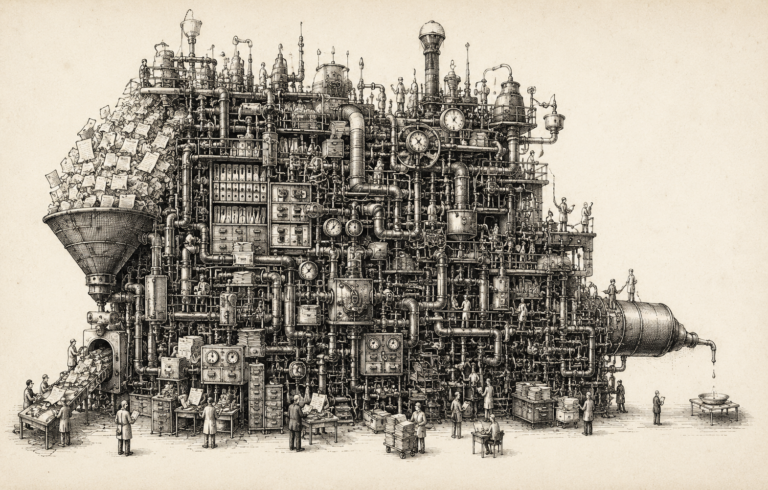
Many others keep working perfectly fine and still fade out. The reason is structural: their function gets absorbed into a larger convenience system, one that is easier to distribute, easier to monetize, and easier to keep people inside.
The original tool becomes “too specific” in a world that rewards “all-in-one.”
Physical mail didn’t stop working. The world simply stopped valuing what it demanded: patience, selection, commitment, and the discipline of writing something that had to survive delivery.
Email is in the same phase. It’s robust, interoperable, decentralized, and still one of the most elegant protocols the mainstream internet ever produced. Yet for most people, it’s no longer a place for correspondence. It has become a background utility for:
- authentication and account recovery
- receipts and notifications
- marketing
- spam triage
It’s difficult to overstate how bizarre that is. A medium built for communication now exists largely to support systems that don’t trust communication.
And maintaining that utility layer is not free. Filtering spam at scale is expensive. Storing years of junk is expensive. Providers will eventually pressure users toward paywalls, shrinking storage, stricter policies, or quiet abandonment. Meanwhile authentication is already shifting toward passkeys, device-bound credentials, and biometric identity flows that bypass email entirely.
If email loses authentication, it loses its last universally tolerated role.
What remains may still exist, but existence isn’t the same as use.
What Email Did Better Than the Tools Replacing It
There’s a strange cultural amnesia around email because people associate it with spam and corporate noise. That’s a fair complaint. It’s also incomplete.
Email forced a certain cognitive posture. It required you to sit down, organize your thoughts, make decisions about priority and audience, and commit to sentences that would persist.
In professional settings, email acted as a friction-based quality filter. A well-written email could prevent a meeting. It could prevent miscommunication. It created a record. It reduced ambiguity. It helped teams coordinate without constant presence.
The meme about “a meeting that could have been an email” isn’t just a joke; it’s a recognition of a lost efficiency. Meetings often exist because nobody took the time to assemble a coherent message.
Many chat platforms reward the opposite habit: constant low-grade presence, rapid reaction, fragmented thought, and the slow erosion of clarity through endless threads.
Yes, you can send PDFs, voice notes, and long files through messaging apps. Yes, collaborative documents can replace many long-form exchanges. But something changes when communication becomes mutable and perpetual — when thoughts remain forever “in progress,” never finalized, never committed, never archived as a completed object.
Email wasn’t perfect, but it was a machine that nudged humans toward finishing their thoughts.
The Internet: From Wild Space to Managed Surface
There’s an even larger example that often goes unspoken because it’s too big to hold in one’s mind: the Internet itself.
In its early cultural imagination, the internet was “the wild west.” Not because it was moral or free of manipulation, but because it was structurally plural. A messy federation of websites and protocols. You navigated. You discovered. You learned the shape of the terrain.
Then came the first major displacement: search engines.
Search didn’t “ruin” the internet. It also didn’t merely help people find things. It reorganized the internet around what was findable through a particular interface. Suddenly the web became a database, and your relationship to it became a query. The terrain was still there, but you experienced it through a narrowing funnel.
After this came the next displacement: social networks.
Social platforms didn’t just become places to post. They became substitute internets: private cities built inside the open world. They offered identity, publishing, messaging, discovery, groups, video, news, commerce — everything in one place. They behaved like a multifunction printer: convenient, compact, seductive — and often worse at each individual function than the specialized tools they displaced.
A platform timeline is not a good news system.
A comment thread is not a good forum.
A social feed is not a good discovery tool.
A “link in bio” is not a good web.
Yet the system wins because it reduces friction and concentrates attention. It “solves” the problem of the open internet by replacing it with a managed surface: curated, filtered, optimized for engagement, and tuned to keep you inside.
Many people today do not experience “the internet.” They experience a handful of apps.
This is not an exaggeration. It is a structural shift in what the internet is for most users: from a network of places to a small set of interfaces that impersonate the whole world.
The Next Displacement: The Interface That Eats the Interface
Now we’re watching another shift, still forming, still unstable: large language models and assistant-style interfaces.
The weird part is that these may not simply compete with social networks; they may compete with the habit of browsing itself.
If search was a funnel, and social platforms were private cities, then LLMs are something else: a conversational front-end that can summarize, repackage, and synthesize information without requiring the user to visit the underlying places at all.
That can be useful. It can also accelerate a pattern we’ve already seen: the further the interface moves from the underlying reality, the more the user’s world becomes a managed projection.
This isn’t about conspiracy. It’s about incentives. The more intermediaries you insert between a person and the raw world, the easier it becomes to filter perception, steer behavior, and reshape what “reality” feels like.
A person who lives inside a feed sees the world as a feed.
A person who lives inside an assistant may start seeing the world as an answer.
And once that happens, the older structure doesn’t vanish; it becomes a backend. A hidden substrate. Like email.

A Theory of Substitution
Here’s the abstract pattern tying all these examples together. It isn’t a law of nature, but it behaves like one under modern incentives:
- A tool emerges that does one thing well.
It’s bounded. Understandable. It teaches a discipline. - A convenience ecosystem arrives that absorbs the tool’s function.
It offers an easier path, packaged with identity, storage, discovery, and distribution. - The ecosystem weakens the discipline the tool enforced.
It reduces friction — and quietly removes the cognitive posture that friction supported. - The original tool survives only as infrastructure or niche practice.
It still works. Fewer people use it. The culture moves on.
The key point is that substitution is not always improvement. It often looks like progress because it increases convenience and adoption. Yet it can reduce quality in ways that are hard to measure:
- clarity becomes optional
- attention becomes fragmented
- memory becomes externalized
- agency becomes conditional
- communication becomes presence
- culture becomes “content”
The new system wins because it lowers the barrier to participation. The cost is paid later, and paid diffusely.
What This Does to Us
Once substitution becomes the default motion of technology, society starts treating depth itself as inefficient.
Albums lose their bounded listening experience.
Cinema loses its shared attention.
Desktops lose their general-purpose agency.
Email loses its reflective discipline.
The open internet loses its plurality.
And the scariest part is that every individual shift can be rational. Each substitution makes sense locally. The problem appears only when you look at the aggregate: a civilization optimized for speed, engagement, and convenience gradually trains itself out of the habits that produce understanding.
That’s why this essay is long. The short form is part of the problem.
There are ideas that don’t fit into a feed. There are connections that require time. There are conclusions that only become visible after repetition, digression, and patience. Old letters and old emails allowed this. They treated thinking as an act worth sustaining.
So this is the closure I would keep in view:
We are not merely watching technologies get replaced. We are watching forms of attention get displaced.
A tool can survive as a protocol, as a backend, as a compatibility layer. What may not survive is the human behavior it once made natural.
And the future won’t announce what it has removed.
It will simply make it inconvenient to keep doing it.
If we want to resist that drift, it won’t happen through outrage or nostalgia. It will happen through deliberate practice: choosing tools that preserve agency, choosing slowness when slowness is the point, choosing communication that forces thought, choosing spaces that allow meaning to exceed the interface.
Because once substitution finishes its work, you can still send an email.
You just might no longer remember why you would.