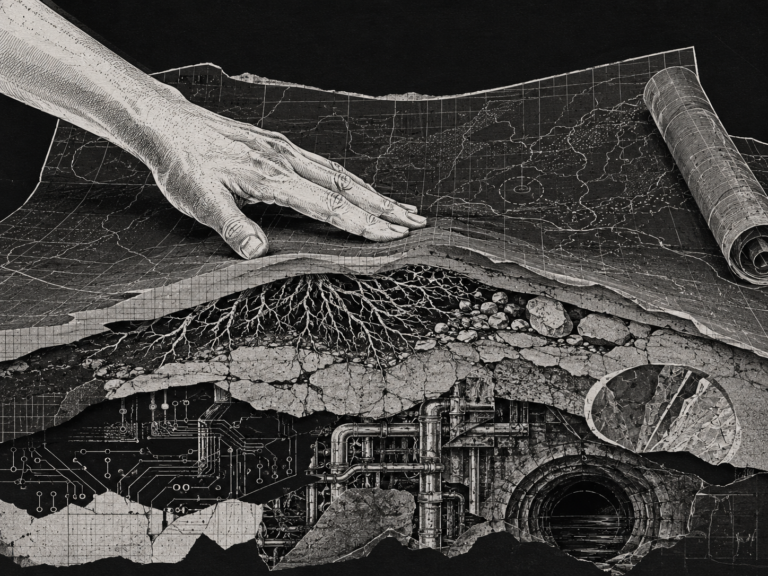

What Mexico’s justice system takes in, and what it gives back.
A Personal Starting Point
This text does not come from abstraction alone.
Like many people in Mexico, I learned early that crime is not an exceptional event reserved for the news. I have been the victim of violent assaults. My best friend, Pablo, was murdered without a clear answer from the system. A serious road accident became years of paperwork, expenses, small corruptions and frustration before the public prosecutor’s office. I have dealt with a stolen car that was harder to report than it should have been. A business I was building in Morelos closed after violent extortion made continuing impossible.
These experiences do not make me an expert, and they are not the subject of this essay. They simply explain the place from which I write. Crime, bureaucracy and impunity are not abstract categories when they have shaped your choices, your work, your friendships and your sense of what the State can actually do.
What follows is not a demand for revenge, nor a partisan complaint. It is a performance question about a public function Mexico cannot afford to keep treating as ceremonial.
The Provider
Imagine you hired a company to provide security and justice.
Not a small company. The largest provider in the country in its field. It has offices everywhere. It has personnel, vehicles, uniforms, laboratories, desks, filing systems, hotlines, courts, prisons, archives, protocols, budgets, public statements and organizational charts. It has a central promise: if something happens to you, if someone robs you, extorts you, threatens you, disappears someone, kills someone, corrupts an authority or breaks the law in a way that harms you, this provider will receive the case, register it, investigate it and carry it toward an answer.
It does not promise that crime will disappear, or that every case will be solved perfectly. But it does promise something basic: that the door will open, that facts will be recorded properly, that evidence will be protected, that serious cases will be built well enough to reach a judge, and that the process will produce some verifiable result.
Now imagine that you already pay for this provider.
You do not receive an invoice labeled “security and justice,” but you pay. You pay taxes. You pay fees. You pay with time. You pay with hours in waiting rooms. You pay with transportation, copies, calls, paperwork, follow-up visits and the energy of insisting. You also pay through adjustments you may no longer notice: closing earlier, avoiding certain roads, not answering certain numbers, installing cameras, raising walls, hiring private security, changing routes, telling people when you arrive, carrying less cash, posting less online, deciding not to report because “what for?”
Sometimes you pay more directly: when a business closes, when someone demands a fee to let you work, when a family moves, when an investor walks away, when a mother searches where the institution did not search, when a witness stays silent. You pay when justice does not arrive as a public right and daily life invents its own insurance, rules and silences.
At the end of the year, you ask for the service report.
The provider says that in 2024 Mexico had an estimated 33.5 million crimes. It says only 9.6 percent were reported. It says not every report opened an investigation file. It says that, even when a file was opened, many cases did not end in anything clear. And it says that only 0.8 percent of all estimated crimes ended with a positive result for the reporting victim.
At that point, the question is not ideological. It is not left or right. It is not “tough on crime” versus “rights-based justice.” It is not a contest between good people and bad people. It is a basic performance question:
If the government were a private provider of security and justice, would you renew the contract?
The honest answer would probably be: not on these terms.
But the problem is that we cannot simply cancel.
We cannot switch prosecutors’ offices the way we switch phone companies. We cannot replace the justice system the way we replace a mechanic. We cannot all move to the state that works better. We cannot accept that the public response to harm depends on luck, zip code, contacts, persistence or the ability to pay for private protection.
That is why the contract question matters. Not because justice should be privatized. Precisely the opposite. It matters because justice is too important to be evaluated with resignation. It turns an abstract discussion about impunity into a concrete question: what enters, what comes out, and where is justice lost?
The Contract Nobody Signs
No one, upon becoming an adult, signs a sheet of paper that says: “I agree to give up private revenge in exchange for the State investigating, sanctioning and repairing serious harm.”
But that contract exists. The idea is simple. We do not resolve serious conflicts by ourselves. We do not personally hunt down the person who robbed us. We do not create family courts. We do not punish with our own hands. We hand that power to the State because, in theory, the State can do it better: with rules, evidence, judges, defense, procedures, limits and public accountability.
In exchange, we expect something.
We expect that if someone reports a crime, the door will open. We expect the case not to disappear at a counter. We expect the authority to record what happened with care, protect evidence, investigate without favors, and know the difference between paperwork and a response.
That contract is never fulfilled perfectly. No country has error-free justice. No system prevents all crime. No human institution converts every case into an impeccable resolution. But there is a large distance between imperfection and abandonment.
Imperfection is when some cases fail.
Abandonment is when failure becomes part of the normal design.
In the working documents for this project, that abandonment has a brutal shape: when unreported crimes and reports that do not become investigation files are combined, 93.2 percent of crimes are not investigated. This is not a marginal failure. It is almost the entire universe of the problem staying outside formal investigation.
When a person does not report because reporting means losing a whole day, the contract weakens. When someone reports and no file is opened, the contract weakens. When a file is opened and nothing happens, the contract weakens. When a body is not identified, when extortion is not investigated, when a disappearance is fragmented across offices, when a victim has to push the case alone, the contract breaks from the inside.
Impunity is not only the final moment when someone is not punished. It is the whole path of broken promises that comes before. It is the accumulation of small and large losses that teach everyone in the system, including criminal actors, that very few cases will reach an answer.
And this is not only about minor crimes or cases that are especially hard to prove. The studies gathered for this project estimate impunity at 96.86 percent for intentional homicide, 98.36 percent for extortion and 99.51 percent for disappearance. When even the most serious crimes encounter so little response, the institutional message is devastating.
This is why the word “impunity” can feel too thin. It sounds like a legal concept, a specialist’s diagnosis, a number cited at conferences. In daily life it is felt differently. It feels like calculation. It feels like exhaustion. It feels like “better not.” It feels like “nothing will happen.” It feels like “they will lose the file.” It feels like “reporting will cost more than staying quiet.”
A society can get used to that. And when it does, the contract still exists on paper, but it stops organizing reality.
What Enters The System
To understand the problem, we have to stop looking only at the final outcome and look at everything that enters the system.
Money enters: security, prosecutors, courts, prisons, forensic services, technology, facilities, vehicles, administration and personnel. The observed civil core of security and justice spending is around 505 billion pesos a year. We are not talking about an apparatus that does not exist.
People enter: police officers, prosecutors, investigators, forensic specialists, judges, public defenders, prison staff, analysts, clerks and administrators.
Rules enter: codes, protocols, manuals, reforms, plans, strategies and internal instructions.
Crimes enter: robbery, fraud, extortion, homicide, disappearance, assault, threats, corruption, family violence, kidnapping, abuse and property crimes.
Reports and evidence enter too: witnesses, videos, phones, documents, bodies, messages, routes, calls, fingerprints, bank records, license plates, names and patterns.
Fear enters too, although it has no budget line: the victim’s fear, the witness’s fear, the investigator’s fatigue, the pressure of criminal groups, the temptation to archive, the risk of investigating too much.
A justice system does not process paper. It processes human conflict under pressure.
That is why it is not enough to ask whether an institution exists. The institution exists. The question is what it manages to do with what enters.
Here we reach a central idea in this project: institutional conversion.
The phrase may sound technical, but the meaning is simple. Institutional conversion is the capacity to transform inputs into results. To convert a report into a properly opened file. To convert a file into a useful investigation. To convert an investigation into evidence. To convert evidence into a case that can stand in court. To convert a case into a resolution. To convert a resolution into sanction, repair, truth or at least a verifiable public answer.
When that conversion fails, saying “there is impunity” is not enough. We have to ask where the conversion failed.
Was the case lost before it was reported? At the entrance? Because no file was opened? Because no one investigated? Because forensic work never arrived? Because the prosecutor’s office was saturated? Because the court had no capacity? Because of corruption, fear or capture?
The difference matters. If we do not know where cases are lost, every solution becomes a slogan. More police. Higher sentences. More technology. More budget. More soldiers. More programs. More offices. More reforms. Each can sound reasonable and still fail if it does not touch the point where the system actually breaks.
What Comes Out
A provider is measured by what it delivers.
It is not enough to have offices, personnel, budgets, apps, conferences, dashboards, reforms or institutional language. If a delivery company boasts about its fleet, warehouses, software and national coverage but almost never delivers the packages, the customer would not say: “What impressive infrastructure.” The customer would say: “It does not work.”
Security and justice are much more serious than parcel delivery, but the performance question is similar. Mexico does not lack institutions in the most basic sense. There are prosecutors’ offices. There are courts. There are police forces. There are forensic services. There are prisons. There are norms. There are budgets. There are buildings. There are systems. There have been reforms.
The question is what comes out.
Does truth come out? Investigation? Resolution? Repair? Confidence? A clear signal that breaking the law has consequences?
Or does the system mostly produce an open file, a pending procedure, a call no one returns, a postponed hearing, a temporary archive, an exhausted victim and an aggressor learning that the system rarely arrives?
This is the uncomfortable part. Many public debates about security stay focused on inputs. How much was spent. How many officers were deployed. How many patrol cars were purchased. How many files were opened. How many arrests were announced. How many reforms were approved. How many coordination meetings were held.
But a system can be full of inputs and produce very few useful outputs. It can receive a lot and convert very little. It can look busy and fail to produce justice.
The difference between movement and result is essential. A victim does not need to know that the file moved from one desk to another. A victim needs to know that someone understood the case, investigated it, protected the evidence, made decisions, and can explain what happened and what comes next. A society does not need only institutional activity. It needs institutional results.
That does not mean demanding miracles. It means demanding conversion.
The Double Bill
When a provider fails, the client does not only lose what was already paid. The client also pays to solve, privately, what the provider did not solve.
First, we pay for the public system. We pay together for security, prosecutors, judges, forensic services, prisons, bureaucracies, buildings, vehicles and information systems. That is the first bill.
Then we pay for what the system does not resolve. That is the second bill.
Part of the second bill appears in households. The direct cost of crime to households is estimated at 269.6 billion pesos. That number does not measure all the damage, but it helps show something basic: when the system does not respond, society does not stop paying. It pays somewhere else.
The second bill appears in visible forms: cameras, bars, guards, insurance, GPS devices, private lawyers, extra transportation, lost workdays and repeated visits to public offices. It also appears in less visible forms: opportunities not taken, businesses not opened, investments postponed, routes abandoned, schedules reduced, conversations silenced.
At the national level, the economic impact of violence in 2024 is estimated at 4.5 trillion pesos. That figure is difficult to absorb because it is so large. It should not be used as decoration. Its value is to force a different question. The price of a more functional system may be high, but the price of the current failure is not zero. It is already being paid.
In some places, the second bill stops being a metaphor. Morelos appears in the project material as an extreme case: the economic cost of violence is equivalent to 43.2 percent of state GDP. That is not merely “insecurity.” It is a large part of local economic life absorbed by violence and its consequences.
There is also an emotional and political bill. Living with fear costs. Insisting before an unresponsive authority costs. Reporting and feeling like an obstacle costs. When people stop believing the institution works, they do not only change their relationship to crime. They change their relationship to the State. They solve outside the system. They remain silent. They learn that the law is often a recommendation for those without enough power to avoid it.
The double bill is a way to understand why impunity is not a sectoral problem. It affects the economy, daily life, mobility, investment, mental health, public trust, politics and the very idea of community.
That is why the question “how much would it cost to fix the system?” is incomplete. We first have to ask: how much does it cost not to fix it?
Existence Is Not Performance
It can be comforting to know that an institution exists.
The prosecutor’s office exists. The court exists. The emergency number exists. The digital platform exists. The specialized unit exists. The protocol exists. The strategy exists. The budget exists.
But existence is not performance.
A clinic can exist and lack doctors. A road can exist and be full of holes. A school can exist and fail to teach. A water treatment plant can exist and fail to treat water. A prosecutor’s office can exist and lack real investigative capacity.
Formal existence is only the first floor of an institution. What matters is capacity.
Capacity does not mean size, budget, an organizational chart or a building. Capacity means being able to fulfill the mission under real conditions: workload, fear, accumulated files, exhausted personnel, complex crimes, possible corruption and distrustful citizens.
A capable institution is not perfect. But it can receive, process and respond. It can know where each case is, distinguish urgency, investigate with method, protect evidence, correct errors, measure delays, learn, resist pressure and explain itself.
An incapable institution can have all the language of a capable institution and still fail to convert.
That is one of Mexico’s central problems: we have learned to recognize the form of institutions, but we do not always demand their performance.
We see the building and assume service. We see the uniform and assume capacity. We see the reform and assume change. We see the platform and assume modernization. We see the budget and assume strength.
But an institution is not valuable because of what it appears to receive. It is valuable because of what it manages to convert.
Where Justice Gets Lost
Justice is not lost all at once.
It is lost in stages.
Sometimes it is lost before it starts, when a person decides not to report. Not because of indifference, but because reporting may take too much time, may not work, may create danger, or may cost more than silence.
Sometimes it is lost at the entrance, when reporting becomes an obstacle course: schedules, lines, requirements, transfers, disconnected systems, stories that must be repeated again and again.
Sometimes it is lost in the file, when a case is registered but not investigated. There is a number. There is a document. There is proof that something was received. But there is no real strategy to clarify what happened.
Sometimes it is lost in evidence, when no one arrives in time, when a scene is contaminated, when video is erased, when a phone is not analyzed, when forensic work takes too long, when a body is not identified, when information sits in a database no one connects.
Sometimes it is lost inside the prosecutor’s office, when a prosecutor has too many cases, when there are no analysts, when investigative police cannot keep up, when archiving is easier than pushing forward, when priority is set by scandal rather than harm.
Sometimes it is lost in court, when the case arrives late, weak or incomplete, when hearings are postponed, when public defense is overwhelmed, when the judge has too much workload.
Sometimes it is lost through fear or capture. The institution exists, but it does not fully obey its mission. It obeys a network, a command, a threat, a habit, a way of not getting into trouble.
To say “there is impunity” without mapping these stages is like saying “the city has no water” without asking whether the problem is at the dam, the pump, the pipe, the valve, the leak, the illegal tap, maintenance or administration. The statement may be true. It is not enough to repair anything.
This essay does not try to repair the system yet. It tries to locate the problem.
Institutional Conversion
The idea of institutional conversion can sound cold. It is not.
It is a way of taking seriously what happens to people.
When someone reports a crime, they are not merely handing over a form. They are handing a piece of their life to the system. They are saying: this happened, this harmed me, this needs to be looked at by someone with authority. If the system cannot convert that act into action, the failure is moral, political and institutional.
Conversion does not mean punishment in every case. Not all cases can end the same way. Some are clarified. Others are not. Some reach trial. Others are resolved through other paths. Some lack enough evidence. Real justice is complex.
But that complexity still requires a functioning system. A system that can say what it did, what it could not do, why, with what evidence, within what time and under whose responsibility.
Institutional conversion does not demand magic. It demands traceability.
It does not demand automatic punishment. It demands investigation.
It does not demand perfect outcomes. It demands that cases not disappear inside the system.
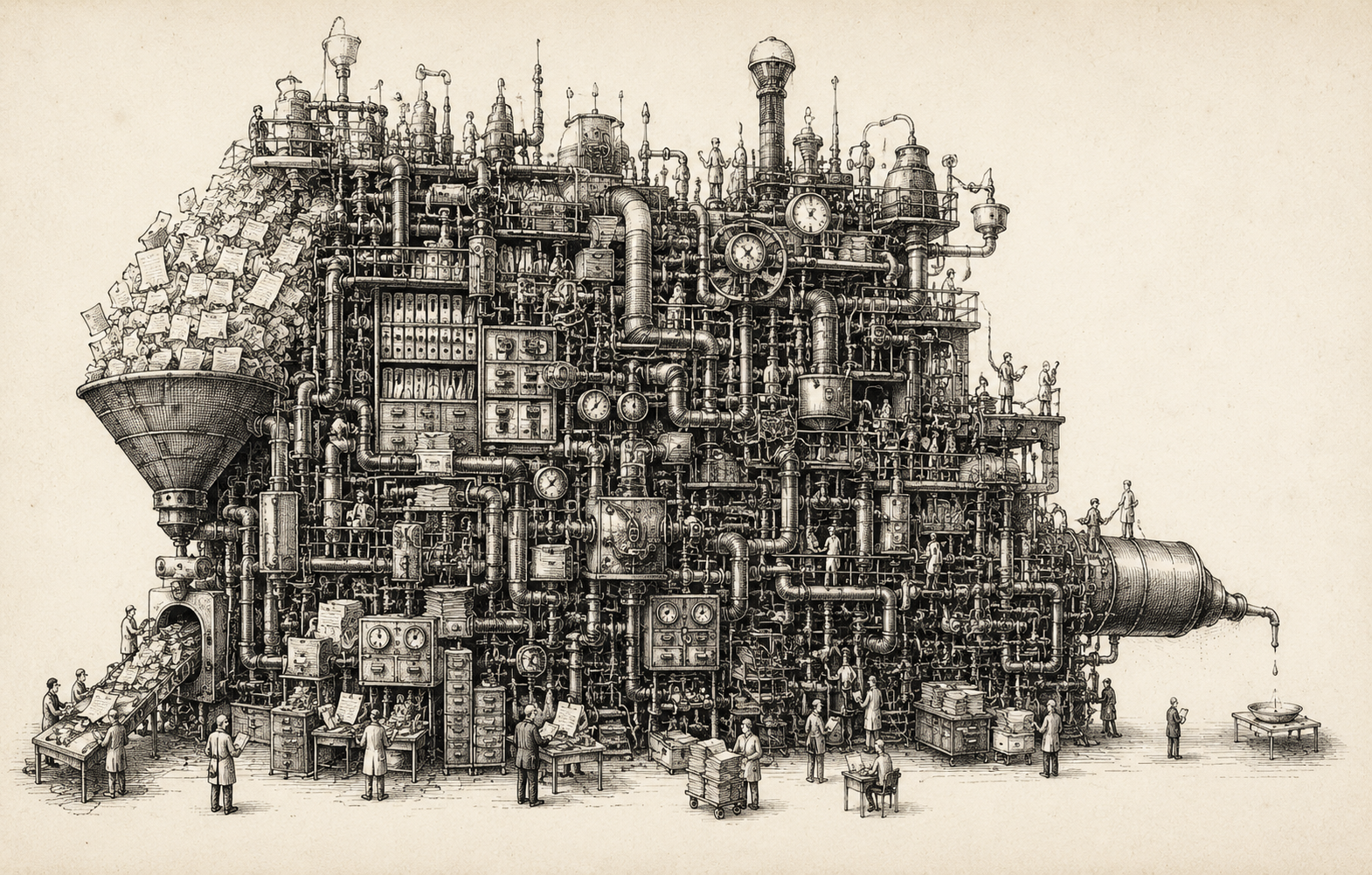
A State with low institutional conversion can spend, hire, reform and announce, while still failing to transform those inputs into sufficient answers. It is like a machine that receives parts, energy and operators, but produces little, produces late or produces defects: because it is badly designed, lacks maintenance, is saturated, is used for another purpose, or stops at a point no one is monitoring.
That image can sound mechanical, but it helps reveal something political language often hides: a system can fail even when many people inside it work hard. It can fail even with budgets. It can fail even with laws. It can fail even with good intentions. It can fail because the process as a whole does not convert.
And when the process does not convert, impunity stops being an exception. It becomes regular production.
Not A Privatization Argument
The provider metaphor has an obvious danger. It can make security and justice sound like private services. They are not.
A citizen is not simply a customer. A victim is not a dissatisfied user. A judge is not an account executive. A prosecutor’s office is not a call center. A case file is not a support ticket. Justice must not depend on who can pay more or insist more.
But that is exactly why the metaphor is useful when used carefully.
In a market, when a provider fails, the client can leave. In the State, exit is not simple. Most people cannot choose another justice system, another prosecutor, another public investigator or another court. They cannot cancel the contract.
That lack of exit makes public accountability more important, not less.
The provider metaphor does not serve to privatize justice. It serves to recover a question that the solemnity of the State often blocks: what are we receiving in exchange for what we pay?
If the answer is “too little,” then the problem cannot hide behind ceremonies, acronyms, reforms or speeches.
Justice is not a consumer good. It is public infrastructure.
That phrase matters. Public infrastructure is not only concrete, cables, pipes and roads. It is also the institutional capacity that allows people to live, work, invest, move, disagree, report harm and expect that rules will be more than decoration. When justice works, it allows other things to happen. When it fails, everything else becomes more expensive.
The working documents estimate that a more functional system would require roughly 705 to 785 billion pesos a year. The figure is large. But placed next to the cost of violence and the second bill already paid by households, businesses and communities, it changes meaning. It is not only a question of spending more. It is a question of whether Mexico wants to keep paying for a system that converts so little.
Do Not Rush To Solutions Yet
The temptation at this point is to jump to solutions.
Make a list. Propose reforms. Say we need to invest here, cut there, copy a model, change a law, create a platform, build an agency, coordinate a strategy. All of that may have its moment.
But before solving, we have to formulate the problem correctly.
If the problem is framed as “there is too much crime,” the solution becomes reducing crime by whatever means. If it is framed as “there is not enough punishment,” the solution becomes higher penalties. If it is framed as “there is not enough money,” the solution becomes a larger budget. If it is framed as “there is not enough technology,” the solution becomes buying systems. If it is framed as “there is not enough will,” the solution becomes changing people.
But if the problem is low institutional conversion, the question changes. It is no longer enough to push more things into the system. We have to see what the system does with what enters. We have to see where it loses cases. We have to see where it becomes saturated. We have to see where it lacks maintenance. We have to see where it is captured. We have to see where it consumes capacity without producing response.
That is the starting point.
Not rushing to solutions does not mean resignation. It means refusing to confuse speed with diagnosis.
A doctor who prescribes before knowing where the failure is can harm the patient. An engineer who increases pressure in a broken pipe can multiply the leaks. A government that increases resources without understanding conversion can feed the same system that is already failing.
Before promising a way out, we have to map the loss.
The Cartography We Are Missing
Return to the provider.
If a company received resources every year, treated most users poorly, lost files, delivered few results, forced clients to buy extra protection and could not clearly explain where cases got stuck, no one would accept a new announcement as a solution.
They would ask for an audit, clear indicators, a map of where the service is lost, an explanation of why some offices work better than others, and an account of how much the failure costs.
With the State, we should ask something similar, with one essential difference: we are not customers buying convenience. We are citizens demanding a public function without which common life deteriorates.
The question “would you keep hiring this provider?” is not meant to produce an easy answer. It is meant to disturb a habit.
Because perhaps the problem is not that the contract does not exist. The contract exists. What is missing is delivery.
To understand why delivery fails, we have to stop looking only at crime and start looking at conversion. We have to look at where cases enter, where they stall, where they leak, where they are abandoned, where they become more expensive and where they stop being anyone’s responsibility.
That is the cartography we are missing.
Not only a map of violence.
Not only a map of crime.
A map of institutional capacity.
A map of where Mexico loses justice.
Author Note
This essay is the first public piece in the Cartografia de la Impunidad project, an attempt to map where Mexico loses justice, money and institutional capacity before cases become truth, accountability or repair.