
Economics and Real Things
1. A Conversation About a Happy World
The conversation happened in the comments section of some social network. It could have been almost any of them. The original post does not matter much, because these discussions rarely stay attached for long to whatever produced them. A remark about work, inequality, property, or the distribution of wealth is enough for the promise of another world to appear, sooner or later.
A world where no one will be exploited. No one will have to devote his life to a job he hates. Resources will be enough for everyone. Technology will perform the unpleasant tasks, and each individual will be free to devote himself to what he truly wants. Hierarchies will disappear along with social classes, and cooperation will replace competition. In that future, poverty, economic anxiety, and much of human conflict will be remembered as unnecessary products of an obsolete system.
The appeal of that image is obvious. I am not interested in mocking it. Many of the people who defend it begin from a sincere concern for the suffering of others. They see exhausting jobs, insufficient wages, fortunes built through political privilege, corporations that control entire sectors of life, and governments that protect those who already concentrate power. Their discontent is not imaginary. Often, the first diagnosis contains real elements.
The problem appears when the conversation tries to move from desire to mechanism.
Who produces what everyone needs? How is it decided what should be produced, and in what quantity? Who performs the indispensable work that no one wants to do? How are resources distributed when they cannot satisfy all preferences at the same time? What happens when two people, communities, or regions have incompatible priorities? Who administers the system? What limits does that administration have? How can the plan be abandoned when its results do not match its promises?
These questions tend to receive surprisingly similar answers. Automation will solve work. Education will transform people. Abundance will eliminate competition. Rational planning will prevent waste. The community will find a collective way to decide. Hierarchies will no longer be necessary once the conditions that produced them have disappeared.
Each answer contains a possible idea, but it moves the problem somewhere else. Automation requires energy, minerals, infrastructure, maintenance, and specialized labor. Education does not eliminate disagreement or make all preferences compatible. Abundance in one good does not imply abundance in all others. Rational planning depends on information no administrator can possess completely. A collective decision, even when presented as legitimate, still needs procedures, authorities, limits, and means of execution. And the legal disappearance of a hierarchy does not prevent another from emerging around access, information, or the power to decide.
These aspirations often appear around the artistic world. Few spaces make the distance so visible between the value a person attributes to his work and the value others are willing to recognize in it. A work may require years of training, discipline, and enormous emotional investment without there being anyone interested in paying for it. That distance feeds the idea that society should guarantee the creator the possibility of devoting himself completely to his work, even when it is not yet clear who would produce the resources needed to sustain that freedom.
The conversation can continue for hours without really leaving its starting point. Every difficulty calls forth a new promise meant to solve it. If resources are lacking, better technology will produce them. If people do not cooperate, proper education will change their conduct. If the administration abuses its power, a purer form of participation will prevent it. If historical experiments ended in authoritarianism, they were not true implementations of the ideal.
The desired system remains intact because every failure can be attributed to an external variable: corrupt leaders, political enemies, sanctions, technological backwardness, a culture still contaminated by the previous system, or an insufficiently rigorous application of doctrine. The possibility that the problem lies inside the model itself rarely manages to enter the conversation.
Once identified, this pattern becomes difficult to stop seeing.
Arguments and counterarguments seem prepared in advance, as if each participant were playing a role inside an inherited script. The same phrases appear in different discussions, spoken by people who have probably never met. There is no coordination, much less a conspiracy. Ideologies offer repertoires of answers. They provide language, moral categories, enemies, acceptable historical examples, and explanations for neutralizing whatever threatens their coherence.
That is why many political discussions do not function as shared explorations of a problem. They function as immune systems.
Each objection is recognized, classified, and answered before it can produce any real internal alteration. The interlocutor’s words are immediately translated into the vocabulary of doctrine: individualism, false consciousness, propaganda, selfishness, privilege, fear of change. What was said matters less than the category in which the person who said it can be placed.
Something similar happens in almost every political tradition. The statist can attribute each abuse to an imperfect institution; the defender of a corporation, to an anomaly of the market; the nationalist, to betrayal; the libertarian, to government intervention. No ideology is completely protected from the temptation to manufacture automatic answers.
Nor do all these positions begin from a sincere, though mistaken, concern for suffering. Some provide a moral justification for avoiding responsibilities or transferring to others the costs of the life one wants to live. A personal preference – not doing unpleasant work, not adapting one’s activity to what others need, not depending on uncertain exchange – can become a general theory about what society owes.
The strength of the utopian argument does not come mainly from its description of the world, but from the moral superiority of what it promises.
Who could oppose everyone having food, housing, health, and time to develop their capacities? Who would voluntarily defend exploitation, misery, or an entire life consumed by absurd work? The institutional question is covered by a much simpler moral one. Whoever doubts the mechanisms seems to be doubting the ends as well.
A political idea is rarely only an intellectual proposition. It can also become an explanation of one’s own life, a community, an identity, and a way of morally ordering the world. To abandon part of it can feel like a loss much greater than admitting an isolated mistake.
Cognitive dissonance is not simple stubbornness. It is a form of protection.
Under those conditions, convincing someone through a public argument is unlikely. Comment sections reward speed, force, and performance before an audience. They leave little room to admit uncertainty, revise a position, or say that the other person has pointed to something worth thinking about calmly. Every concession can be read as defeat.
Even so, I do not think these conversations are entirely useless.
The doubt may not appear during the argument. It may appear much later, when the person encounters a similar contradiction in another context, when a personal experience makes the old explanation insufficient, or when a political promise collides too obviously with its consequences. At that moment, an old question may return.
Not necessarily the answer. The question.
How would this work in reality?
That question introduces a fundamental difference between imagining a desirable world and understanding the conditions needed to build it. It forces a descent from ends to means, from intention to consequences, and from the moral coherence of an image to the material resistance of things.
The problem with a happy world is not that someone desires it. The problem begins when desire presents itself as explanation, when emotion replaces mechanism, and when reality is treated as a docile material that will eventually take the shape of our good intentions.
2. Economics, Matter, and Limits
We usually imagine that economics begins with money.
Before coins, banks, debts, and markets, there would seem to be only nature: an expanse of available matter, not yet marked by price, property, or administration. Economics would appear later, as a human construction laid over the world, accompanied by its conventions, institutions, and conflicts.
But money does not create what economics tries to describe. It only provides a particularly efficient – and also imperfect – way of representing relations that existed before it: availability, scarcity, effort, displacement, transformation, risk, and choice.
Long before anyone could assign a price to an object, some things were already in one place and not another. Some were abundant and others hard to obtain. Accessing them required time, energy, and exposure to danger. Using a resource for one purpose prevented using it simultaneously for another. Life itself depended on administering, even without conscious intention, a limited and irregular distribution of matter and energy.
Human economics does not arise on a neutral surface. It is the conscious prolongation of a much older problem.
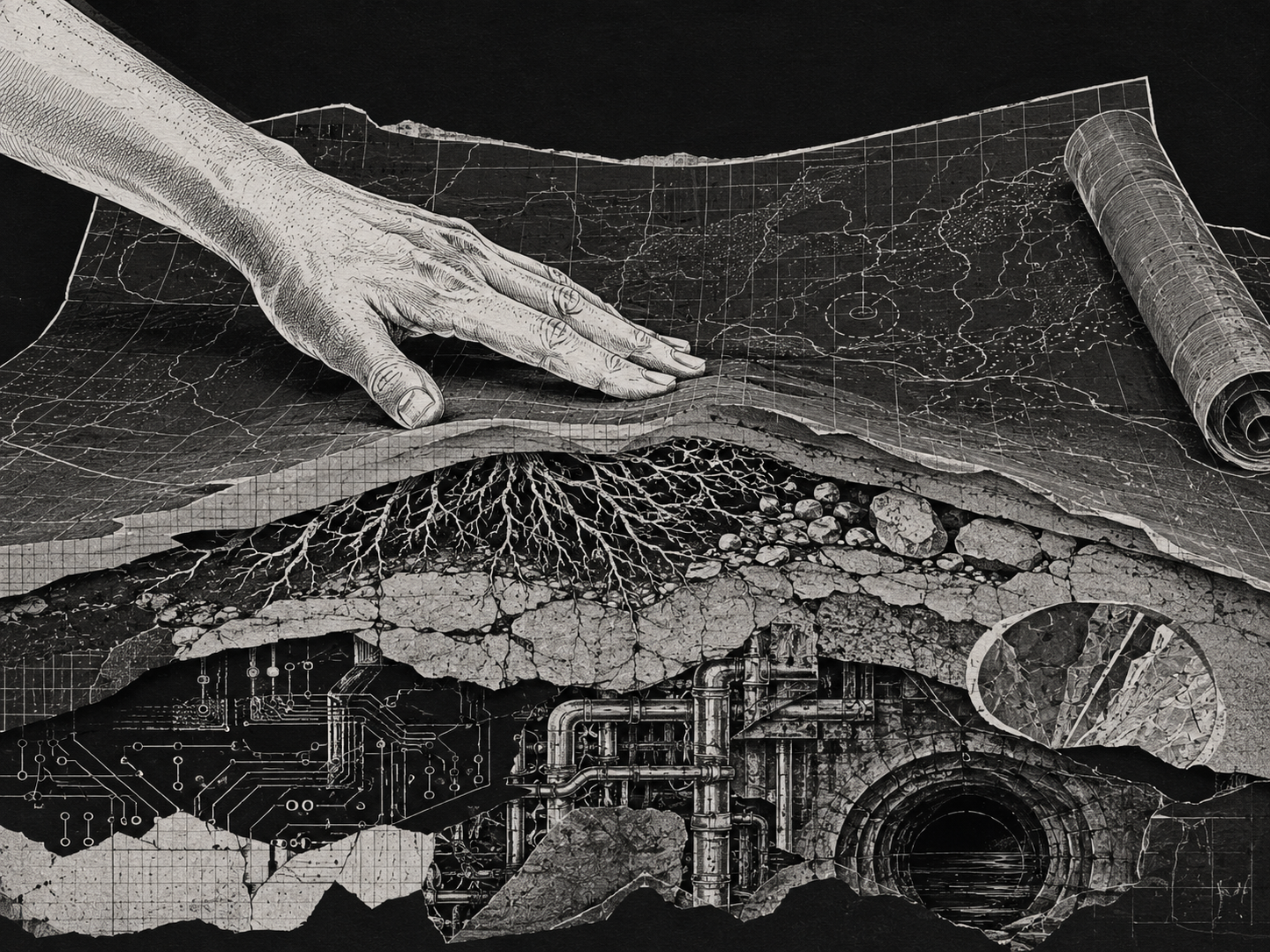
A forest can be seen as a complex organization of flows. Sunlight arrives in limited quantity and under changing conditions. Trees raise their trunks and extend their crowns to intercept it. Their forms do not respond to a common plan or to an agreement about how energy should be distributed. Each organism grows within the possibilities it finds and, in doing so, modifies the possibilities of others.
The canopy of a jungle captures much of the available radiation and produces a different environment below: less light, greater humidity, different temperatures, and other rhythms of decomposition. What is a limitation for some species opens a niche for others. Shade-adapted plants, fungi, insects, microorganisms, and animals develop their existence within conditions produced by earlier organisms.
Trees compete for light, but their competition does not merely consume a resource. It reorganizes the environment.
Each organism receives something, transforms something, and leaves something behind. Fallen leaves become matter for fungi and bacteria. The remains of an animal feed other beings and return nutrients to the soil. The waste of one species can become the condition of existence of another. A structure produced for one function – a root, a hollow trunk, a dam, a reef – can create shelters and opportunities the responsible organism never intended to offer.
There is competition, but also cooperation, symbiosis, parasitism, and dependence. None of this requires a central authority to distribute functions. Nor does it presume harmony. An ecosystem can degrade, suffer an invasion, lose diversity, or collapse. Nature guarantees neither justice nor stability nor proportion. What we call equilibrium is often only a temporary configuration of forces that continue acting.
The forest does not have an economy in the human sense. Trees do not calculate prices, sign contracts, or choose professions. Yet the forest shows material conditions on which any economy will have to be built: limited energy, unequally distributed resources, competition for access, transformation of the environment, and the emergence of new opportunities from previous activities.
It also shows something too-simple theories often forget: an intervention does not modify only what it touches directly. It changes the entire field of possibilities.
Cutting down a dominant species may free light and space, but it may also remove shade, humidity, protection, and relationships on which many other organisms depended. Eliminating a predator may seem beneficial for its prey until the multiplication of the prey exhausts the vegetation that sustained it.
Complex systems do not remain still while we intervene in one of their parts.
Something similar happens in society. A technology, a law, a subsidy, a tax, or an infrastructure does not produce only the effect stated in its description. It transforms incentives, movements, prices, behaviors, and relationships that may not have been visible to the person who made the decision.
The railroad did not merely transport people faster. It altered land values, created towns, destroyed older routes, changed schedules, concentrated goods, and produced new trades. The internet was not simply a more efficient way to send information. It dismantled intermediaries, created others, made new communities possible, and allowed concentrations of power that could not previously exist at that scale.
Every solution casts a shadow.
And inside that shadow, new activities, dependencies, and forms of life appear.
The analogy can be extended without turning it into an equivalence. The universe, too, does not distribute matter and energy uniformly. There are concentrations, voids, differences in temperature, pressure, and density. Gradients make movement possible. Water flows because there is an unevenness. A battery can do work because it maintains a separation between states that tend toward equilibrium.
Without differences there would be no flow.
The analogy does not try to turn galaxies into market participants or thermodynamics into economic theory. It serves to recall something more modest: systems acquire structure and activity because their resources and conditions are not perfectly distributed.
Every human economy also begins with a difference.
Something exists in one place and is missing in another. One person possesses a capacity another has not developed. A region produces certain foods and needs materials found far away. Someone has time, someone else has tools, and another has knowledge. Exchange appears because human beings are not self-sufficient and because reality does not place everything necessary within the immediate reach of each individual.
The fundamental inequality of economics is not, first of all, a moral inequality. It is an inequality of situation.
Resources are irregularly distributed. People have different bodies, knowledge, interests, aptitudes, and circumstances. The time each person can use is limited. Needs appear at different rhythms. Even if all wealth were divided identically at a given instant, differences would reappear immediately because people would make different decisions and face different conditions.
Recognizing this does not justify every social inequality or turn every accumulation of power into a natural and inevitable phenomenon. Slavery, political privilege, expropriation, and monopoly do not become legitimate because nature contains differences.
The consequence is more uncomfortable and more precise: not every inequality is the product of conspiracy, injustice, or defective organization. Some differences precede institutions, and others emerge even inside systems that try to suppress them. The political problem is not to eliminate all difference, but to determine which differences should be tolerated, which should be limited, and what means may legitimately be used to intervene in them.
Economics appears when a being capable of choice encounters a world that cannot offer everything at the same time.
Every decision then acquires a cost. Not necessarily a monetary cost. Choosing one activity means renouncing, at least for the moment, another. Dedicating a plot of land to corn prevents using that same surface to build a house. Using metal in one tool means not using it in another. Spending an afternoon composing a song means not spending those hours repairing a roof, resting, or caring for someone else.
The most basic cost of a thing is what we must give up to obtain it.
This condition does not disappear inside a family, a religious community, a cooperative, or a communist state. It may change how decisions are made and how their consequences are distributed, but it does not eliminate the need to choose among incompatible alternatives.
Even an extremely abundant society would still face limits. It may produce enough food and lack housing in a particularly desired place. It may automate much physical work and continue to depend on energy, minerals, maintenance, and human time. It may copy information at almost no cost, but it cannot infinitely multiply the capacity to understand it.
Abundance solves particular scarcities. It does not abolish scarcity as a condition.
Eliminating money does not eliminate economics either. It only eliminates one of the languages used to express it.
Without prices, resources still have to be allocated. Someone must decide which project receives materials, which need is met first, and which activity must wait. Decisions can be made by custom, vote, authority, lottery, reputation, kinship, force, or lines. Some mechanism will always exist, even when society refuses to recognize it as such.
When an official price disappears, cost can reappear in other forms.
It can be paid in time standing in line, in obedience to an official, in personal connections, in political belonging, in future favors, or in privileged access to information. Resources do not stop being scarce because they stop being sold. Sometimes only the person with the authority to distribute them changes, and so does what a person must surrender in order to obtain them.
Legally abolishing classes also does not guarantee the disappearance of hierarchies. Unequal access can reorganize itself around administration, information, prestige, proximity to power, or the ability to interpret the rules. Formal property may disappear while the material faculty to decide who uses each thing remains intact.
Whoever administers the resource exercises a form of property, even if he cannot legally sell it.
Economics, understood this way, is not an ideology or a defense of the contemporary financial system. Nor is it synonymous with capitalism. It is the study of a difficulty no political system can avoid: how limited beings act inside a limited world.
The market is one possible answer. Planning is another. So are reciprocity, gift, tradition, and communal property. In practice, all societies combine mechanisms. Even the most capitalist firm contains internal planning, and the most egalitarian community depends on exchanges and agreements that cannot be completely centralized.
The relevant question is not whether a society will have economics, but how it will recognize its limits and who will have the capacity to decide within them.
The Compass and the Map
Emotions matter inside that question. Not only because they are an inevitable part of human experience, but because they often detect something before we can explain it. Indignation can point to an injustice. Fear can warn us of danger. Compassion can make visible a suffering that statistics, institutions, or custom had managed to hide.
Emotion can be an initial form of knowledge.
Confusion begins when that first signal is taken for a complete explanation.
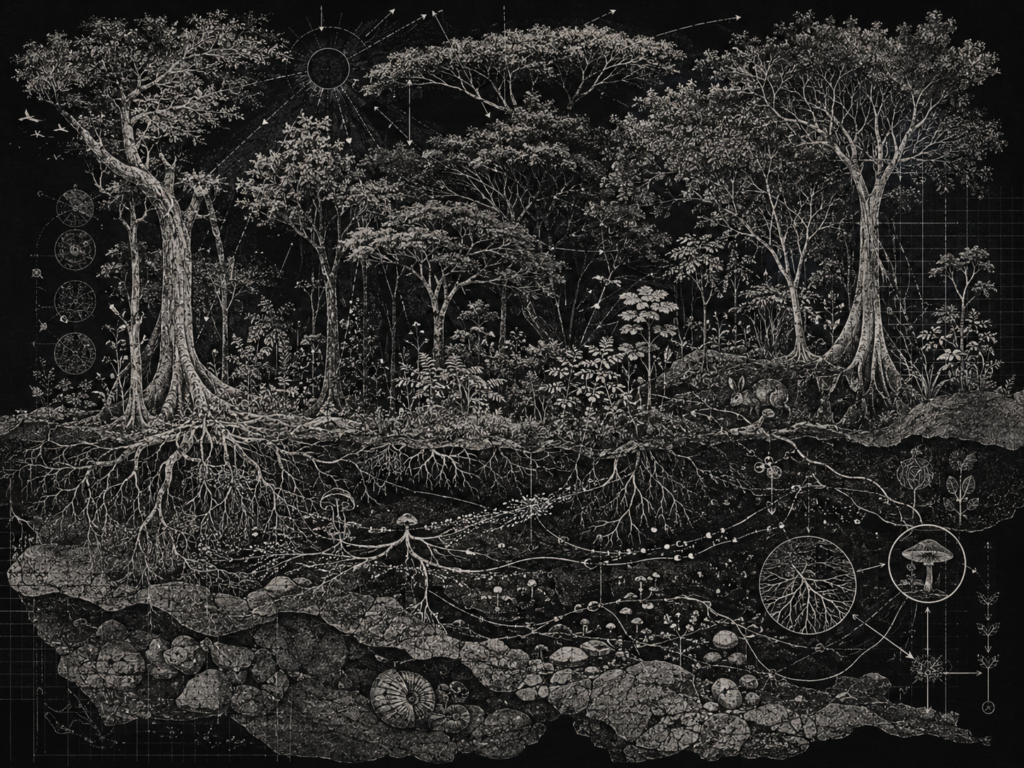
A compass can indicate a direction. It does not show the terrain, the obstacles, the distances, or the available paths. It does not tell us whether ahead there is a river, a mountain, a border, or a cliff. Nor does it guarantee that moving in a straight line is the best way to arrive.
Emotions resemble that compass. They tell us that something matters, that a situation requires attention, or that there is a distance between the world and what we consider desirable. They do not by themselves provide the mechanisms needed to transform that situation.
Between emotion and action there is a space no good intention can eliminate.
That space is occupied by knowledge, experience, calculation, comparison, prudence, and the possibility of being wrong.
Much contemporary political discourse treats that space as if it were a moral evasion. Asking how a proposal will work can be interpreted as a form of insensitivity. Pointing to its costs can sound like a defense of the suffering it seeks to correct. Remembering uncomfortable historical experiences can be presented as a refusal to imagine alternatives.
Thus the analysis of means is subordinated to the nobility of ends.
An intention does not contain its consequences.
Human beings do not act on an inert surface. We intervene in systems composed of other people, each with partial knowledge, interests of their own, different capacities, and responses that are hard to anticipate. A law modifies conduct. A prohibition creates incentives. A subsidy alters prices. An administrative obligation produces strategies to comply with it, evade it, or exploit it.
People do not remain still while a policy acts on them.
A policy based on absolute trust is not necessarily more humane. It may simply be less prepared to face abuse.
A broad moral tradition – religious, philosophical, and legal – has insisted on a prudent intuition: the human being has dignity, but is also fallible. He can love, cooperate, and create; he can also lie, rationalize, dominate, and use others for his own ends. That anthropology matters less for its exact genealogy than for its institutional usefulness: any system that forgets human fallibility ends up handing too much power to those it claims to have purified.
No social class, profession, identity, or ideology monopolizes virtue.
The entrepreneur can exploit. The official can abuse. The worker can deceive. The artist can use his vulnerability as an instrument of manipulation. The academic can turn a theory into a source of prestige. The activist can discover that a cause lets him control others. The priest can use faith as protection. The revolutionary can love power more than justice.
Human fallibility does not disappear when someone adopts the correct vocabulary.
Many political projects seem built as if certain individuals would magically overcome those limitations once placed at the service of a noble cause. The owner is distrusted, but the administrator is trusted. The merchant is suspected, but not the planner. Private economic power is condemned, and a far greater coercive capacity is handed to the official.
A prudent institution does not need to deny human goodness. It only avoids depending entirely on it.
Limits, counterweights, procedures of exit, competition among alternatives, and division of power do not exist because no one can act with integrity. They exist because we cannot know in advance who will do so, for how long, and under what circumstances.
The most important political question is not who deserves to govern when everything is working well.
It is what the person who governs can do when he no longer deserves to.
The visible usually has a moral advantage over the invisible. A fired worker, a sick child, or a family expelled from its home has a face, a story, and a concrete body. Indirect costs appear dispersed and often remain without a narrator.
Economics forces us to think about those absences too.
Not because human well-being can be reduced to numbers, but because decisions produce consequences even when no one can tell the story of those who suffer them. A responsible policy must try to observe both what it gives and what it prevents.
That task requires imagination, but an imagination different from the utopian one. Not the ability to describe a perfect world, but the ability to anticipate how an intervention may deviate, be captured, or produce effects opposite to those desired.
Prudence is not a lack of imagination. It is imagination applied to failure.
Faced with complex problems, a prudent answer is usually reversible, limited, and open to correction. It allows comparison among alternatives, learning from mistakes, and abandoning what does not work. It avoids concentrating so much power that admitting an error becomes politically impossible.
But the more complete a transformation is, the harder it becomes to distinguish what caused its results, correct its errors, or return from it.
The world becomes an experiment without a control group.
When reality contradicts the project, a dangerous temptation appears: to attribute the failure not to the map, but to those who refuse to follow it. If production falls, someone is sabotaging. If differences persist, the population retains incorrect values. If a parallel market appears, residues of selfishness remain. If people abandon the project, they have not been sufficiently educated.
The resistance of the world becomes a moral fault.
Then the emotion that originally pointed to suffering can end up justifying another. Compassion for one group becomes hostility toward those who obstruct its liberation. The promise of equality requires discipline. The community needs surveillance. The construction of the happy world begins to identify enemies.
A system is not safe because its first administrators are good. It is safe when even a less good person finds it difficult to turn it into an instrument of domination.
That is why freedom cannot depend only on someone feeling correctly. It requires spaces where people can dissent, exit, experiment, associate, and build alternatives without asking permission from a single center.
Decentralization does not eliminate error. It distributes it.
It allows bad decisions, failed projects, and even unjust communities to exist. It also limits the scale of their consequences and preserves the possibility of learning from other paths. A centralized error can become a national destiny. A local error can remain a warning.
Emotion should not be expelled from politics or economics. A society without compassion can be efficient and monstrous. A theory incapable of recognizing humiliation, loss, or fear will be describing beings that do not exist.
But emotion must be subjected to the same scrutiny as any other source of knowledge.
It must ask what it has seen and what it may be ignoring. It must distinguish immediate suffering from future consequences, a real need from a seductive solution, the desire to help from the desire to control.
The compass remains necessary.
Without it, the map can take us with enormous precision to a place we never wanted to reach.
But a compass without a map can lead us straight to the precipice.
Economics begins where omnipotence ends. Perhaps that is why it produces so much discomfort. It reminds us that every project must be built with something, that someone must do the work, and that every promise hides a decision about what will be sacrificed. It forces us to translate desires into matter, energy, time, and responsibility.
Reality does not oppose our ideals. It is simply not obliged to obey them.
3. Value, Price, and Power
We say that something is worth a lot as if value were a substance contained inside things.
A house is worth a certain amount. A painting is worth millions. An hour of work is worth a certain wage. A computer program is worth the price of its license. Everyday language turns complex relations into apparently simple properties, as if every object carried a hidden objective number we only needed to discover.
But something can cost a great deal to produce and sell for almost nothing.
It can also cost very little and sell for an enormous amount.
It can be indispensable to one person and useless to another. It can have an emotional value impossible to translate into money and no demand at all. It can be technically extraordinary, commercially successful, or culturally important without those conditions coinciding.
Value is not one thing.
There is material cost: resources, tools, energy, space, and transport. There is human time invested, which is not homogeneous either. An hour of work can depend on years of learning, responsibility, risk, attention, experience, or technical capacity. There is usefulness: what a thing allows one to do, solve, avoid, or enjoy. There is personal or symbolic value: the importance something has within a life, a family, a community, or a tradition. And there is price: the amount someone manages to obtain in an exchange under certain conditions.
These dimensions are related, but none completely contains the others.
An object may require months of work and interest no one. A medicine may cost little in materials and mean the difference between life and death. A family photograph may have no commercial value and be irreplaceable to the person who keeps it. A digital file may reproduce at almost no cost and be sold repeatedly for a considerable amount.
When we say that a thing is worth what someone is willing to pay for it, we are saying something important, but incomplete.
In a concrete exchange, the realizable price depends on a person’s willingness to give something in return. If no one wants a product, the effort used to create it does not oblige the rest of the world to recognize it through a purchase. Labor invested can explain part of the cost, but it does not create demand by itself.
This reality is especially difficult within art.
A work may contain years of training, hundreds of hours of labor, and an intimate part of the experience of the person who produced it. It may be honest, technically complex, and deeply important to its author. None of that guarantees that another person will want to acquire it.
The market does not automatically reward effort, sincerity, or difficulty.
Nor does it necessarily reward quality.
A superficial work can find a huge audience. Another, much more elaborate, can pass unnoticed. A piece can sell because of institutional prestige, the author’s reputation, fashion, speculation, scarcity, or the influence of those who exhibit it. Even inside spaces that present themselves as opposed to the market, value can depend on relationships, curators, juries, public funds, and networks of legitimation.
What does not sell does not therefore lack value. Commercial value is only one form of recognition and cannot be confused with a total evaluation of the work.
There is also a less comfortable conclusion: the personal value we attribute to our work does not impose an automatic obligation on others.
I may consider what I do indispensable. I may need to do it in order to preserve a form of balance, identity, or meaning. I may devote an enormous part of my life to it. But if I expect other people to finance that activity, I must explain why they should do so, what they receive in exchange, or under what voluntary agreement they accept sustaining it.
Society is not an abstract entity that deposits resources without extracting them from anywhere.
When a grant, institution, or fund finances an activity, someone has previously produced the resources that will be transferred. The discussion does not end by declaring that a work, a research project, or an initiative is valuable. It barely begins the question of who determines that value, who pays, and under what criteria.
This problem does not belong only to art.
In the market, a firm can earn enormous profits not because it produces something valuable, but because it controls a license, an infrastructure, a regulation, or a privileged position.
Receiving money does not prove that value has been created.
Not receiving it does not prove the opposite.
Price is a signal, not a sentence.
And like every signal, it depends on the system in which it appears.
A person may be willing to pay a lot because something is useful, pleasurable, or scarce. He may also do so because he is desperate, lacks alternatives, or has been placed inside a relation of dependence. The price of a bottle of water in a city with abundant supply does not mean the same thing as its price during a drought.
Willingness to pay can express desire, but also urgency, fear, or vulnerability.
Price does not reveal a moral essence. It describes the point at which a need, an ability to pay, and a bargaining position manage to meet.
The existence of a buyer does not make any price just. The absence of one does not make what no one can buy useless. Yet ignoring willingness to pay completely also leads to mistakes. It is a form of information about what others desire, prioritize, or are willing to sacrifice.
In an open economy, that information is dispersed among millions of people. No one possesses a complete list of all needs, preferences, capacities, and available alternatives. Price emerges from multiple partial decisions. It may be distorted by monopolies, subsidies, coercion, incomplete information, or inequality of power, but it still transmits something a central administration can hardly reconstruct from above.
The difficulty lies in not confusing the usefulness of that signal with a perfection it does not have.
Prices can coordinate. They can also lie.
They can indicate real scarcity or manufactured scarcity. They can reflect the cost of producing something or the capacity of someone to prevent others from producing it. They can emerge from open competition or from a regulation designed to exclude competitors.
A patent, a license, a border, a mandatory certification, or a dominant platform can raise the price without increasing the usefulness or material cost of what is being sold.
In those cases, part of the price does not remunerate creation.
It remunerates control of access.
This difference becomes especially visible in digital goods.
Creating a program, a song, a film, a book, or a database can require a considerable investment. It requires knowledge, time, tools, infrastructure, electricity, and coordination. The first copy may have been extraordinarily expensive.
But once produced, reproduction may cost almost nothing.
This separation between initial cost and marginal cost deeply alters the traditional relation between production and property. A physical object cannot be in two people’s hands at the same time. A file can be copied without the original disappearing.
If I take someone else’s tool, I prevent its owner from using it. If I copy an idea, a song, or a fragment of code, the author keeps what he created.
That does not eliminate his right to recognition or the need to find ways to remunerate his work. But it makes it less obvious that the same logic of property used for rival objects should be applied without modification to information.
To preserve a high price over something that can be reproduced almost for free, a restriction must be introduced.
The restriction can be legal, technical, contractual, or infrastructural: copyright, DRM, restrictive licenses, closed formats, authentication, servers controlled by the provider.
Thus scarcity ceases to come exclusively from the nature of the good and begins to be administered.
There is a real problem: someone who invests years in developing something needs means to recover his work. If any competitor can immediately copy the result without assuming the initial cost, the production of certain goods can become difficult to sustain.
Recognizing that problem does not require accepting the current architecture as the only possible solution.
Contemporary copyright can extend for periods that far exceed the commercial life of a work. Patents can be accumulated by corporations that do not develop what they control. Creators can lose their rights to intermediaries with greater contractual power. Universities can finance research with public resources and then place the results behind private barriers.
Intellectual property, theoretically designed to protect creation, can end up protecting catalogs, rents, and dominant positions.
The individual creates.
The institution accumulates.
And over time, what began as a temporary incentive can become an inherited or corporate monopoly.
There is also a cultural paradox. Every creation depends on previous materials. An artist learns from other works. A scientist begins from accumulated discoveries. An engineer uses tools, languages, and standards developed by generations. Innovation rarely appears from nothing.
Even what we call original arises inside an ecosystem of influences, borrowings, corrections, and simultaneous discoveries.
The problem is to find ways to remunerate the difference created by an individual without allowing that difference to be used to block indefinitely the development of everyone else.
The question should not be only how to ensure that someone can charge.
It should also ask what he is allowed to control, for how long, and with what consequences for the rest of society.
Here the difference between value and power appears again.
A company can charge a great deal because it produced something extraordinary.
It can also charge a great deal because it has managed to ensure that no one else can offer an alternative.
Both situations produce income, but they do not represent the same phenomenon.
In a healthy economy, reward should be linked, at least approximately, to the capacity to solve problems, create usefulness, assume risks, and use resources efficiently. In a captured economy, reward can depend more on controlling licenses, regulations, platforms, financing, or political access.
Profit then ceases to be a signal of productivity and becomes a signal of position.
This also happens with work.
Not every hour is worth the same because not every hour produces the same result or depends on the same knowledge. One person can solve in minutes a problem another could not solve in weeks. The value of that intervention is not in the amount of time consumed, but in the accumulated capacity that made the result possible.
But not all work can be reduced to an immediate metric either. The value of a teacher, a caregiver, a researcher, or a technician responsible for preventing failures can be hard to observe. Sometimes the result is a learning that will take years to appear. Sometimes it consists in a catastrophe that did not occur.
Measuring productivity only through visible units can be as misleading as ignoring it altogether.
The difficulty is to evaluate without turning every activity into a bureaucratic table.
Economic freedom does not consist only in allowing someone to sell. It also requires allowing others to compete, to copy what should not be monopolized, to abandon a platform, to repair their tools, and to build alternatives.
Otherwise, the defense of the market can become the defense of those who already control the market.
What someone is willing to pay remains one of the clearest expressions of economic value. It reveals that a person prefers what he receives to what he gives. But that decision must be observed within its real conditions.
Are there alternatives? Is the information sufficient? Was the need artificially created? Does the price remunerate production or privilege? Can the exchange be refused without losing access to something essential?
These questions do not destroy the logic of exchange. They make it more precise.
Value cannot be determined by a universal committee. Nor can it be reduced to the will of the producer or to the number that appears in a transaction.
It is a mobile relation among resources, needs, capacities, desires, institutions, and power.
That is why one thing can cost a lot, be worth little, and sell for a high price.
Another can cost little, be worth enormously, and never sell.
Understanding that difference is indispensable for discussing work, art, property, and technology without turning price into an absolute measure or personal desire into a collective debt.
Economics does not tell us what we should love.
It forces us to ask what we are willing to give up, who assumes the cost, and what structure makes it possible for something to be sold.
4. Abundance Enclosed
One of the most radical promises of digital technology was the almost infinite multiplication of certain goods.
A book could be copied without cutting down more trees. A song could travel without manufacturing discs. A film could be distributed without trucks, warehouses, or shelves. A program could be installed on millions of machines without the original copy disappearing. Knowledge could circulate with a speed and breadth no physical library, university, or publisher had ever achieved.
For the first time in history, a significant part of human culture seemed to separate itself from the material scarcity that had accompanied it for centuries.
Not completely. Nothing digital exists outside the physical world. Files need servers, drives, electricity, networks, minerals, screens, cables, antennas, and human bodies capable of producing, maintaining, and understanding what circulates. But the relation between creation and reproduction had changed decisively.
The first copy could still be costly.
The following ones could approach zero.
That difference contained an enormous civilizational possibility. If a good can be reproduced without destroying the original, if sharing it does not deprive the creator of his copy, if distribution costs less and less, then many forms of knowledge, tools, and works could circulate with a freedom previously unthinkable.
Technical abundance opened the possibility of reducing certain forms of dependence.
A student could access texts that would previously have remained locked in distant libraries. A musician could publish without a record label. A programmer could share code with strangers on other continents. A community could organize archives, forums, servers, learning systems, and networks of collaboration without asking permission from a central institution.
For a moment, the internet seemed to lean in that direction.
It was not a pure space, nor an innocent one, nor free of conflicts. But it did contain a decentralizing promise: to reduce intermediaries, expand the capacity to publish, make copying easier, lower distribution costs, and allow small communities to build their own infrastructures.
Digital abundance did not abolish economics, but it altered some of its conditions.
Many business models were not prepared for abundance of that kind. If copying, distributing, and preserving become too easy, much of the power of intermediaries weakens. The business can no longer depend only on producing a thing and selling each unit as if each copy required the same material cost.
Then a temptation appears: to artificially rebuild the scarcity that technology had eroded.
Sometimes for legitimate reasons. There are understandable reasons to protect a work, recover an investment, sustain creative labor, or prevent a third party from immediately capturing the result of years of effort. But that initial justification can expand until it becomes an entire architecture of control.
Scarcity no longer appears only because a good is difficult to produce or because its materials are limited. It appears because someone manages to control access.
The file exists, but it cannot be opened without authorization.
The song exists, but only inside a platform.
The film exists, but it can disappear from the catalog.
The book exists, but it cannot be lent, copied, or freely preserved.
The program exists, but it stops working if it cannot verify a license.
The tool exists, but it depends on a remote server that can change its conditions.
Technical abundance becomes administered scarcity.
This transformation rarely presents itself as loss. It almost always presents itself as convenience.
Many of these promises are partly true.
The cloud can prevent losses, streaming can open enormous libraries, automatic updates can correct dangerous flaws. Convenience is not a simple lie; that is why its full cost appears later.
Every comfort delegates a capacity. Every delegation creates a dependence. Every dependence hands another person or institution part of our practical autonomy.
Not having to decide means that someone decides.
Convenience can be a soft form of surrender.
Not every convenience is bad. Some free us from unnecessary tasks. Others train us to live without capacities we may need when the system stops treating us as desirable customers.
Dependence becomes invisible because the system works.
Until it stops working.
A service changes price. A platform removes a function. An account is suspended. A company closes. A digital library loses licenses. A file becomes trapped in a proprietary format. A tool requires permanent connection. An identity policy requires documents, biometrics, or additional verification.
Then we discover that what we considered ours was, in fact, conditional access.
Buying No Longer Means the Same Thing
The word buying no longer means the same thing.
For a long time, buying a tool implied a relatively clear relation. A person gave money and received an object. That object could deteriorate, become obsolete, break, or require maintenance, but within its physical limits it remained under the control of the person who had acquired it.
A hammer did not require an account. A bicycle did not need to authenticate with the manufacturer. A book could not be removed from its reader’s personal library because a publisher changed its contracts. Ownership had limitations, but it also granted practical sovereignty.
To own something meant being able to use it without asking permanent permission.
The digital economy has weakened that difference.
Today we can pay for something and yet not own it in a functional sense: a film locked inside an account, a video game dependent on servers, an application tied to a subscription, years of work stored in formats only one platform interprets correctly.
Ownership becomes an interface.
Permission becomes reality.
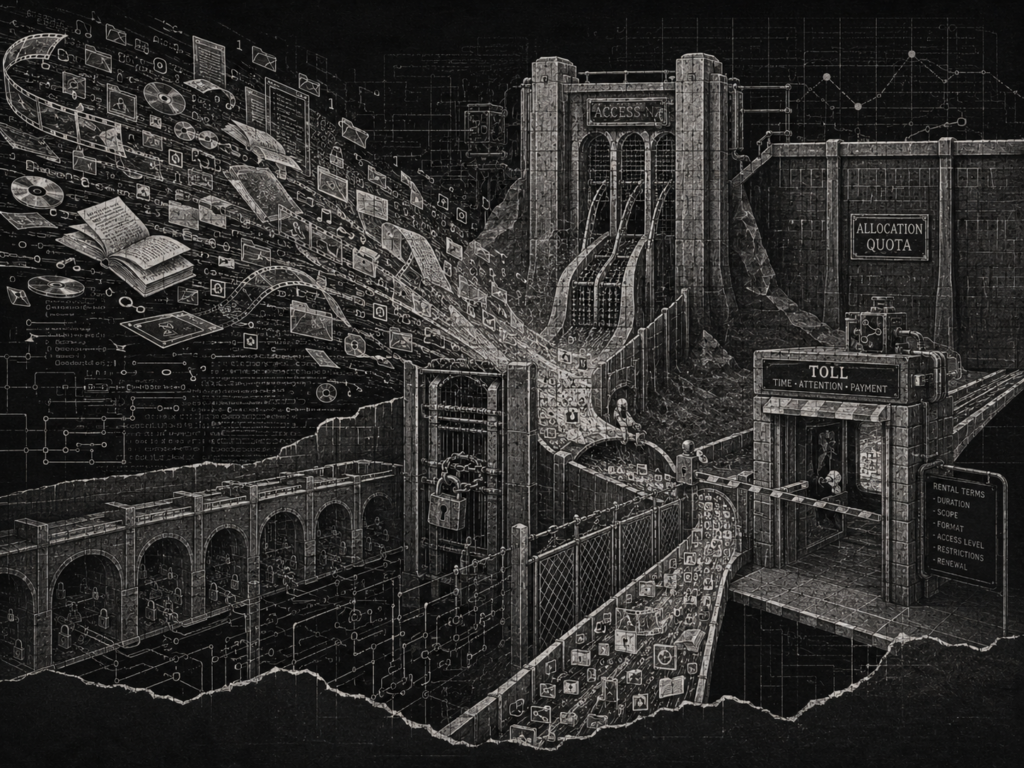
The button says buy, but the contract says license.
The user believes he is acquiring a work, but receives the revocable right to access it under certain conditions. He cannot freely transfer it, preserve it outside the authorized system, repair it if it stops opening, or continue using it when the platform changes.
The word ownership remains in the interface as a psychological illusion.
The legal and technical reality looks more like a lease.
When a tool depends on permanent authentication, an external server, or a license that can be changed unilaterally, it ceases to be fully the user’s tool.
It becomes a relation.
And in every relation of dependence, it matters who can end it, modify it, or watch it.
When a product becomes a service, the center of gravity changes. The question is no longer only what the tool can do, but who controls the conditions under which that tool can continue doing anything.
Locally installed software can be abandoned by its developer and continue working for years. An abandoned service disappears. An old program can remain frozen in time; a service can change even when the user does not want to change. A local file can be backed up; a file trapped inside a platform depends on the export options that platform decides to offer.
The product obeys its technical limits.
The service also obeys political, contractual, and commercial limits.
But delegating is one thing; being enclosed is another.
A service could expand capacities without destroying previous ones: sync without preventing local copies, update without blocking basic use, collaborate without enclosing files. The contemporary economy tends to prefer the enclosure.
From a business point of view, the reason is obvious. A product sold once produces revenue once. A service produces recurring revenue, data, dependence, opportunities for additional sales, and control over the user’s life cycle.
The commercial relation no longer ends with the sale.
It begins with it.
This alters incentives. If the user owns the tool, the company must convince him to buy another version. If he depends on it, the company can modify prices, reduce functions, introduce plans, change terms, or add requirements without exit being easy.
Power accumulates on the side of whoever controls continuity.
That is why so many platforms seek to become ecosystems. It is not enough to offer a better tool. It is useful to control files, identity, contacts, histories, payments, and integrations. Each element raises the cost of leaving. The user does not stay only because leaving is technically difficult, but because leaving means rebuilding habits, files, relationships, payments, reputation, and operational memory.
Permission becomes habit.
And habit becomes dependence.
The service lives inside the permanent present of the company that administers it. If a work stops being convenient, it disappears from the catalog; if a function gets in the way, it is removed; if a plan no longer pays, it is restructured. I have written about this silent retreat of tools and functions in The Silent Retreat of Useful Things; what matters here is its economic consequence: cultural memory and practical capacity become subordinated to renewed permissions.
The point is not nostalgia for simpler objects. An old tool could be bad, limited, uncomfortable, or fragile. The difference is that its limits belonged more to its matter and design, not to a permanent relation of authorization. When the tool becomes a service, technical defect and commercial decision begin to blur.
The same pattern advances over physical objects. Tractors, cars, printers, appliances, and phones can be materially in the user’s hands and still depend on authorizations, serialized parts, applications, servers, or diagnostics controlled by the manufacturer. The matter is still there; its use is subordinated to a layer of permission. Legal ownership of the object coexists with a technical dependence that decides what can be repaired, when, and under what conditions.
This displacement becomes more serious when it affects basic capacities: communication, work, transportation, food production, access to information, community organization, education, and health. In those domains, dependence ceases to be a consumer annoyance and becomes social vulnerability.
If a community cannot repair its tools, preserve its archives, operate its communications, or maintain its systems without external authorization, it may look modern and connected, but it does not control the conditions of its own continuity.
This is the difference between access and capacity.
Access allows one to use something while someone else’s infrastructure remains available and favorable. Capacity allows one to act even when that infrastructure fails, changes, or withdraws.
A society can have abundant access and increasingly weak capacities.
Dependence does not always feel like poverty.
Sometimes it feels like modernity.
That is why the language of innovation can be misleading. Some innovations increase the capacity for extraction, surveillance, blocking, or segmentation; others turn an old property into a subscription.
The relevant question is not only what a technology does. It is also what it prevents us from doing without permission.
These transformations can seem small because the user receives something in return.
Convenience always offers something.
We rarely know how much it will cost to recover it later.
Digital abundance showed us that many things could circulate with less friction, fewer intermediaries, and less dependence. The contemporary economy responded with an architecture designed to regain control over that circulation.
Sometimes it did so to sustain legitimate work.
Sometimes to protect real investment.
But many other times it did so to extract rent, watch users, close ecosystems, and transform technical freedom into conditional access.
Technology can multiply the power of the individual. It can also multiply the power of those who administer his access to the world.
The difference is rarely in the isolated tool. It is in the economic, legal, and technical architecture that decides whether that tool expands our capacities or makes us dependent on a permission.
Abundance did not disappear.
It was enclosed.
And now it is leased back to us, fragment by fragment, under the name of convenience.
5. From Permission to Authentication
Once tools depend on permissions, the next displacement is almost natural: permission needs an account, and the account needs an identity.
I have developed the figure of the legible citizen in more detail in The Quest for the Transparent Citizen II. Here I am interested in its economic reflection: the user who does not lose rights through an explicit prohibition, but capacities through lack of recognition within an architecture of permissions. In the transparent citizen, power wants to know who you are, where you are, and under what identity you act. In the perpetually authenticated user, the decisive question is what you can preserve, open, repair, move, or continue when the system stops recognizing you. Identity appears not only as political data, but as an economic condition of use.
Today, much of digital life begins with an account. The account requires an email; the email, a phone; the phone, a SIM; the SIM, perhaps documents, address, biometrics, or registration before an authority. Then come devices, payment methods, histories, contacts, location, and recovery systems. Each layer promises security or convenience. Each layer also reduces the possibility of acting without being translated into an administrable profile.
The user ceases to be someone who uses a tool.
He becomes an entity that must remain authenticated in order to preserve access to his capacities.
Identity becomes infrastructure.
This seems reasonable when presented as protection. No one wants his bank account stolen, his identity impersonated, his files emptied, or his name used to commit fraud. Authentication has legitimate uses. Weak passwords, unprotected accounts, and open systems without limits can cause real harm.
But permanent authentication is becoming the default condition for participating in ordinary life.
More and more activities require proving who we are, not only proving that we have the right to perform a specific action. Communicating, working, storing files, moving money, or keeping a phone line can become tied to systems of identity that grow in scope and depth.
The question stops being: can I do this?
It becomes: does the system recognize me as someone authorized to do it?
That difference seems minor until something fails.
A password is lost. A phone is stolen. An account is suspended by mistake. An algorithm detects suspicious activity. A document does not match. A number is deactivated. A platform demands additional verification. A government entity changes its requirements. A provider decides that a region, behavior, word, payment, or association increases risk.
Then the user discovers that he did not merely lose access to an application.
He lost a key that opened many other doors.
Cumulative authentication creates dependencies in chains. An email account recovers other accounts. A phone verifies the email. The email permits entry into the bank. The bank pays services. Services preserve files, work, communication, and memory. The loss of one point can spread through the entire system.
Digital identity promises order, but it also concentrates fragility.
This phenomenon connects with the transparent citizen, but it is not identical. In the political sphere, legibility is demanded through registries, personal data, fiscal surveillance, or civil identity. In the corporate sphere, it presents itself as contract, security, account recovery, fraud prevention, or improved experience. The difference matters: the state possesses legal coercion; the company, in principle, offers services. But when certain services become indispensable, the two worlds begin to touch. Coercion no longer needs always to present itself as an order: it can appear as a technical requirement, a condition of use, anti-fraud verification, or a mandatory update.
A dominant platform may not imprison anyone, but it can expel someone from spaces where he works, sells, gets paid, speaks, or preserves his work. A payment provider may not be a judicial authority, but it can freeze the capacity to receive income. A digital store may not legislate, but it can decide what software exists for millions of users.
Societies have always needed some form of identification. A contract, a debt, a property, an inheritance, or a legal responsibility requires linking acts to persons. The contemporary difference lies in scale, integration, and automation: records once separated by material friction can now form a continuous profile.
The anomaly can be minimal: a trip, a change of device, a different IP address, an unusual payment, an expired document, or a database error.
In an architecture of permission, administrative error becomes existential experience.
The person knows he exists, but the system does not recognize him.
This is one of the most unsettling features of digital modernity: the human being can be subordinated to incomplete representations of himself. If the record fails, if the profile does not match, if the algorithm decides there is risk, human explanation arrives late, when it arrives.
A concrete life is reduced to a file that cannot defend itself.
Traditional bureaucracy already produced this alienation. The difference is that digital bureaucracy can operate at greater speed, greater scale, and with less face: a screen, a form, an automatic email, or a suspension without a real interlocutor.
Authority becomes interface.
And the interface has no compassion.
The modern user does not enter the system once.
He remains in the act of entering.
This dynamic transforms even our everyday psychology. We learn to behave as users under evaluation: moderating words, accepting permissions, verifying accounts, keeping phone numbers for fear of losing access, and adapting our practices to what platforms consider normal. Not necessarily out of terror. Often out of exhaustion.
Once tools depend on accounts, and accounts depend on identity, technical control becomes social control. An activity does not have to be prohibited in the abstract if those who try to carry it out can be blocked. Private infrastructure can execute public pressures; public authority can delegate restrictions to private infrastructure. Between them appears a gray zone where responsibility is diluted.
The government can say it did not censor, only requested cooperation. The company can say it does not govern, only applies terms of service. The user is trapped between decisions he cannot vote on as a citizen or negotiate as a real customer.
Formal freedom remains.
Practical capacity diminishes.
Many platforms function as de facto identity services. An email, a social account, a phone number, or a payment profile can become master keys. Whoever loses them does not lose only access to the original provider. He loses reputation, contacts, files, sales channels, and ways to prove continuity.
Dependence on identity is not only technical.
It is biographical.
A user may have built years of existence inside an account. Suspension may look like an administrative event to the platform and like an amputation to the person who depended on it.
This reveals another dimension of the problem: the concentration of trust. A functional society needs trust, but distributing trust is not the same as concentrating it. If everything converges in a few accounts and a few providers, the failure of one can drag too much with it. Resilience depends on redundancy, and convenience tends to eliminate it.
Friction can protect. At this point, the issue touches again the problem of privacy and partial opacity: not as a romantic refuge against all identification, but as a defense against an administrative unification that makes every act correlatable. Here it is enough to retain its economic reverse: without friction, a single technical, commercial, or political authority can drag too many capacities at once.
This should force us to think about authentication with greater prudence. Different activities require different degrees of name, proof, memory, and exposure. Buying bread, reading an essay, paying taxes, opening a bank account, or signing a contract do not belong to the same category. The error begins when maximum verification becomes the norm for ordinary acts.
Here the central question of the essay returns: reality is not modeling clay. Nor are people. We are not coherent profiles, clean accounts, or complete files. We are contradictory, local, historical, changing creatures, partially unknown even to ourselves.
An architecture that demands constant legibility ends up punishing that complexity.
The more essential authentication becomes, the crueler its failures become, especially for those who live outside the normal case: the poor, the elderly, migrants, dissidents, people without stable documentation, rural inhabitants, victims of violence, or individuals who have legitimate reasons not to hand over certain data.
The answer to this cannot be to abandon digital life. The problem is structural: we need systems that allow degrees, alternatives, and ways out; less identity than necessary, less dependence on a single account, more real portability, and more continuity outside permanent authorization.
And above all, a culture that once again values the capacity to do things without continuous permission.
Authentication should be a tool, not a form of existence.
When everything depends on remaining authenticated, the person no longer moves through a world of objects, relations, and agreements. He moves through a network of renewable permissions. Each door opens while a database allows it. Each capacity exists while an account remains healthy. Each tool works while a server recognizes him.
We have not lost only privacy.
We have lost continuity.
The continuity of a life that can preserve its documents, its tools, its memories, its relationships, and its work beyond the mood swings of an institution.
An account is not a home.
A profile is not an identity.
Access is not capacity.
And permission is not freedom.
The perpetually authenticated user lives surrounded by possibilities, but many of them do not belong to him. They are available, abundant, immediate, elegant, synchronized, and comfortable. They are also conditional.
The task is not to reject every condition, but to remember that a society where all access is conditional must answer an uncomfortable question:
what remains of a person when systems stop recognizing him?
6. Recovering Capacity
The answer to the economy of permission cannot be a fantasy of absolute self-sufficiency.
No individual can produce by himself all the objects, services, food, tools, medicines, knowledge, and infrastructures on which he depends. Human life has always been interdependent. Even the most elementary gesture rests on layers of other people’s work: roads, languages, trades, electrical networks, crops, machines, learning, norms, and relations no individual invented from scratch.
Autonomy does not consist in depending on no one.
It consists in preventing too many dependencies from being concentrated in too few hands.
A person can depend on others and preserve room for action. He can buy food without submitting to a single provider, use tools manufactured by someone else and still repair them, hire a service and keep copies, participate in a network without handing over his entire archive, identity, and working capacity to a single administrator.
Dependence itself is not the center; dependence without exit is.
Recovering capacity begins by reversing, at least partially, that direction.
Using the cloud, commercial software, subscription services, or platforms can be reasonable. There are remote services that save time, reduce costs, allow collaboration, and solve problems one person alone could hardly address. The question is whether those services expand our possibilities or completely replace capacities we will later no longer know how to exercise without permission.
A simple criterion can help: a healthy tool should make exit easier for the person who uses it.
Not because everyone will leave, but because the possibility of doing so modifies the relation of power. A provider that knows its users can migrate files, keep copies, and change tools must behave differently from one whose users remain trapped by accumulated dependence.
Exit does not need to be comfortable. It only needs to be real.
That is why open formats matter. At first glance they seem like a technical detail, something reserved for programmers, archivists, or system administrators. But a format decides who can read a file, with what tool, in how many years, and under what conditions. When a document can only be opened correctly inside a specific application, the content is tied to the commercial and technical continuity of that application.
A file that is truly ours should be able to survive the program that created it.
The same is true of local copies. In an age of constant synchronization, keeping one’s own files can seem redundant. The cloud promises that everything will be available from anywhere. And often it is. But the local copy does not compete with the cloud; it corrects it. It introduces a layer of continuity that does not depend on the state of an account, the price of a plan, an automatic suspension, or the survival of a company.
Redundancy looks inefficient until it becomes necessary.
Recovering capacity means accepting some friction: backing up, learning, preserving, repairing, migrating. The list matters less as a manual than as a principle. Part of freedom has always had that form: keeping a skill alive before needing it.
The right to repair belongs to the same family of problems. There is no need to romanticize the user who fixes everything with his own hands. Many people do not have the time, knowledge, or desire to repair their devices. The point is that someone can do it: the owner, an independent technician, a community, a local workshop, a cooperative, a small business. When repair depends exclusively on the manufacturer, the object remains physically near the user but functionally subordinated to a distant authority.
Repair distributes power.
It also distributes knowledge. A community that can open, study, and modify its tools understands the world it inhabits better. It does not need to master every detail, but it preserves a less magical relation with objects. It knows that things have parts, decisions, materials, failures, alternatives. That understanding makes passive obedience to systems that present every restriction as inevitable more difficult.
Free software and open source perform a similar function in the digital realm. Their value does not consist only in something being free of charge. Reducing them to gratuity impoverishes the idea. What matters is the possibility of studying, modifying, sharing, auditing, adapting, and continuing a tool beyond the will of a specific provider.
An open program can be abandoned, forked, translated, repaired, or incorporated into another project. It will not always happen; many open projects are fragile or capturable. But even with those limits, they introduce a fundamental difference: operational knowledge is not completely enclosed.
The tool leaves a door open.
This matters for small communities, artists, schools, radio stations, family businesses, and projects that cannot depend forever on the price or policy changes of a global platform. An open tool allows adaptation before supplication, the maintenance of modest infrastructure without permanent permission, and local correction.
Local-first begins from a similar intuition: the user’s data and work should live first near him. The network can synchronize, back up, and collaborate, but it should not become the absolute condition for a person to access what he made.
It is design for continuity, not nostalgia for a disconnected past.
Decentralization does not promise purity. It can be uncomfortable, unequal, insecure, or hard to use. But its failures often have another scale: when many people control small parts of an infrastructure, no single administrator can alter the conditions of everyone at once. Diversity introduces political redundancy, not only technical redundancy, and prevents the error of some from automatically becoming common destiny.
Centralization is often justified by efficiency, security, and user experience. Sometimes rightly. But efficiency seen from the center does not always coincide with freedom seen from the edges. A uniform system is easier to administer, watch, monetize, and correct. It is also easier to capture.
Plurality is disorderly. That is part of its function.
Recovering capacity also requires a different culture toward convenience. It is not enough to have technical alternatives if people have been trained to consider any friction intolerable. The dominant market has understood very well that comfort defeats many resistances. It does not need to convince the user philosophically to abandon ownership; it is enough to offer an experience comfortable enough for the loss to seem abstract.
That is why autonomy must become practical, not puritanical.
Everyday sovereignty is made of small measures.
Not all of them are heroic. Many are boring. But lost capacities rarely disappear through a single visible defeat. They are lost through convenience, fatigue, accumulated delegation, and the feeling that someone else will solve every detail better.
The problem is that someone else will not always be there. Or he will be, but under new conditions.
This recovery of capacity has an obvious economic dimension. A person who can repair, migrate, back up, or change providers negotiates from a different position. He is not forced to accept any price, any surveillance, or any contractual modification. He can continue depending on others, but not in the same way.
Real competition needs the possibility of exit.
Without that possibility, the market becomes a choreography of choice. The user compares plans, colors, interfaces, or brands, but all roads lead to the same architecture: mandatory account, captive data, revocable license, controlled repair, growing subscription. Superficial competition hides a deep convergence.
Recovering capacity is also recovering the possibility that different models may appear.
This plurality can grow through local decisions, technical communities, small businesses, limited regulations that prevent abusive closures, and cultural habits that value exit. It does not need to become a total doctrine in order to be real.
It is worth avoiding, however, the symmetrical illusion to the one being criticized. Decentralization is not Play-Doh either. It is not enough to declare it desirable for it to work. It requires maintenance, responsibility, standards, security, cooperation, and sustainable ways to finance labor. A poorly maintained server can be a risk; an open project without resources can die.
Autonomy also has costs.
Precisely for that reason it must be thought seriously, not as an aesthetic. If we want open tools, someone must write them, review them, document them, and maintain them. If we want repair, there must be parts, manuals, workshops, and knowledge. If we want our own archives, we must care for them. If we want alternatives, we must be willing to tolerate a certain imperfection while they mature.
Capacity is not recovered by consuming a product called independence.
It is recovered by practicing, financing, and sustaining conditions of independence.
Here economics appears again in its most basic form. Every autonomy needs resources: time to learn, money to maintain infrastructure, people capable of teaching and repairing, communities that share knowledge, and institutions that do not turn exit into an infraction.
Material freedom does not appear by decree. Nor by desire.
It must be built with real things.
That principle may seem modest beside the great political promises. It does not offer a reconciled society or the abolition of all conflicts. Precisely for that reason, it can be corrected.
But perhaps that modesty is a virtue.
A political project that begins with concrete capacities can be corrected more easily than one that seeks to remake the whole of society. It can test, fail, adapt, and coexist with other models. It does not need to wait for the final transformation of humanity. It works with real people: comfortable, tired, creative, contradictory, capable of learning and also of abandoning what demands too much from them.
Recovering capacity does not mean living outside the contemporary world.
It means inhabiting it with more than one door open.
The economy of permission reduces that margin in the name of comfort. The recovery of capacity tries to expand it in the name of continuity. Between them, an important part of contemporary freedom is at stake: not the abstract freedom to declare preferences, but the material freedom to preserve means of action when conditions change.
A society that preserves distributed capacities can face error, crisis, and abuse better. Not because its individuals are more virtuous, but because no center can absorb its power completely. Some file remains outside, some tool repairable, some parallel network, some transmitted trade, some small server, some community capable of continuing.
That is not enough to save a civilization.
But it can prevent its entire life from depending on a password.
7. Imagination Submitted to the World
Imagination is one of the most dangerous and necessary faculties of the human being.
Without it there would be no art, science, exploration, political reform, or technology. No one would have crossed an ocean without imagining that something might exist on the other side. No one would have built a flying machine without first admitting an image contrary to everyday experience. No unjust institution would have been questioned if someone had not been able to conceive another way of organizing life.
To imagine is to open a crack in what is given.
It allows us to look at a custom, a law, a misery, or a technical limitation and say: this does not have to be so. That phrase can begin a work, an investigation, a business, a revolution, or a small domestic improvement. It can produce beauty, alleviate suffering, and widen the field of the possible.
But the same faculty that lets us discover possibilities can separate us from the conditions that make something possible.
In imagination, resistances disappear easily. Resources arrive when needed. People cooperate as they should. Conflicts dissolve once their cause is understood. Institutions obey their stated purpose. Administrators act wisely. Tools work. Systems do not corrupt. Costs remain outside the frame.
Every mental simulation simplifies the world.
That does not make it useless. If we tried to think with every variable present, we could not think anything. Abstraction is necessary. A map must omit almost everything in order to be useful. An economic model, a political theory, or a work of fiction selects elements and leaves others in shadow.
Confusion begins when we forget that there was a selection.
Then the map is confused with the territory, the model with society, and desire with a viable architecture. Reality ceases to be a resistant set of material, historical, and human conditions, and becomes moral modeling clay: something that should take the correct form if enough will, education, technology, or power is applied.
This confusion appears often in political utopias, but it does not belong only to them. It is also present in urbanism that designs cities like diagrams and forgets how people walk. In bureaucracy that imagines citizens as complete files. In the technology company that reduces communities to metrics of interaction. In financial economics that treats real resources as infinitely recombinable abstractions. In education that speaks of forming ideal subjects without observing the concrete children in front of it.
Every field has its own modeling clay.
An imaginary material on which it believes it can impress a form without meeting too much resistance.
Total ideologies make this temptation especially dangerous because they do not limit themselves to proposing a reform or a local experiment. They aspire to reorganize the whole. If the problem is the entire structure of society, then the solution must also be complete. It is not enough to correct institutions, open spaces, reduce abuses, or allow alternatives. The system must be remade from its foundation.
But the more total a transformation is, the less space it leaves for learning.
A limited project can fail and be corrected. A community can try a form of organization and abandon it. A company can go bankrupt. A tool can be replaced. A small error can preserve the scale of a warning.
A utopia administered from the center does not fail so easily. It has invested too much power, prestige, and symbolic violence in demonstrating that it represents the future. When its results do not match its promises, admitting the error threatens not only a concrete policy, but the legitimacy of the entire project.
Then reality becomes suspect.
If production falls, someone is sabotaging. If people disobey, they retain incorrect values. If parallel markets appear, selfishness has not been educated. If hierarchies persist, the transformation has not advanced far enough. If people flee, they have been deceived by external enemies. If the plan requires more coercion, coercion is justified as defense of future emancipation.
The utopia is not wrong. Reality betrays it.
This moral inversion allows a desire to liberate to end up building mechanisms of surveillance, censorship, and punishment. The goodness of the end absorbs the gravity of the means. Every material or human resistance is reinterpreted as a political fault. The happy world needs administrators, and the administrators need power to correct those who still do not fit the promised world.
Here appears a question every political imagination should answer before demanding obedience:
What will the project do when reality does not cooperate?
Not when its defenders are generous, resources abundant, and the population enthusiastic. That is easy. The test comes when materials are lacking, when people do not respond as expected, when incentives produce side effects, when some refuse to participate, when administrators discover they can benefit from their position, and when costs begin to accumulate in places the model had not foreseen.
A policy should be judged not only by the world it promises, but by the kind of power it needs in order to pursue it.
This question also helps examine the present. Contemporary corporatism does not present itself as an egalitarian utopia. Its language is different: efficiency, innovation, security, experience, scale, convenience. But it too imagines a docile world, composed of legible users, predictable consumers, connected objects, verified accounts, and financial flows capable of absorbing all activity.
Its Play-Doh is not redeemed humanity, but administered humanity.
The result can be less dramatic than a revolution and therefore harder to observe. No one needs to expropriate all goods if he can turn them into services. No one needs to prohibit all dissent if he can move it outside the relevant infrastructures. No one needs to abolish property if he can empty it of functional capacity. No one needs to force everyone to hand over their data at once if each service, each procedure, and each device requests it separately in the name of convenience.
Contemporary power rarely demands absolute surrender.
It prefers to accumulate small delegations.
The user accepts synchronization, authentication, verification, modifiable terms, dependence on a platform, and inability to migrate. The citizen accepts registries, identifiers, digital procedures, fiscal surveillance, biometrics, and cross-validations. Each step seems reasonable within its own context. The sum produces a form of life in which access is granted from increasingly concentrated systems.
Administrative imagination does not dream of abolishing scarcity.
It dreams of controlling its doors.
That is why this essay cannot be reduced to a critique of communism or to a simple defense of the market. Both formulations would be too narrow. The same distrust must be applied to every project that turns an abstraction into a license to concentrate power: the people, the nation, science, efficiency, security, progress, the market, justice, tradition, innovation, or democracy.
No word makes a structure innocent.
The question always returns to mechanisms: who decides, with what information, under what limits, with what possibility of exit, paying what cost, and on whom the errors fall.
Economics, understood as the relation between limited beings and limited things, forces those questions to remain open. It reminds us that every promise needs energy, time, materials, knowledge, and responsibility. That a work desired by its author does not automatically become a need of others. That a convenient service can hide dependence. That a compassionate policy can produce effects contrary to its ends. That an abundant technology can be enclosed in order to sell back access to what could already circulate.
Reality does not punish our ideas out of malice.
It simply contains more variables than our imagination.
This should produce humility, not resignation. Humility does not require accepting everything that exists as natural or inevitable. Many scarcities are manufactured. Many institutions protect privileges. Many prices reflect control more than creation. Many hierarchies are not the result of merit or spontaneous difference, but of violence, capture, and legal design. Recognizing the limits of the world does not mean blessing every way those limits have been administered.
On the contrary: a serious critique needs to distinguish between a real limit and a manufactured limit.
Not being able to use the same metal in two tools at the same time is a real limit. Preventing repair of a machine in order to preserve a service monopoly is a manufactured limit. That every creation requires time and work is a real limit. Extending corporate control for generations over works culturally absorbed by society is a manufactured limit. That certain contexts require identification is a real limit. Turning every everyday activity into a permanent identity test is a manufactured limit.
The political task consists, in part, in recognizing that difference.
If we confuse real limits with oppression, we will pursue destructive fantasies. If we confuse manufactured limits with nature, we will accept unnecessary servitudes.
Freedom does not consist in denying scarcity. It consists in preventing someone from using it as a pretext to administer our entire life.
Here decentralization offers a modest but powerful answer. It does not eliminate error, inequality, or abuse; it recognizes the insufficiency of every center.
No authority knows enough. No institution remains incorruptible. No model anticipates all consequences. No majority is automatically right because it is a majority. No market remains free if it is allowed to merge with the political power that should limit it. No community is protected from its own forms of conformity, exclusion, or abuse.
Precisely for that reason, capacity should be distributed.
Allow many routes, tools, communities, providers, and spaces of exit. Not to guarantee that all will be good, but to prevent a single bad decision from organizing everyone’s life.
Plurality is a form of prudence.
It does not arise from naive faith that individuals will always know what to do. It arises from the opposite suspicion: because all of us can be wrong, it is better to prevent our errors from becoming too large.
This idea also corrects a frequent caricature of individual freedom. Freedom does not mean each person should live isolated, without obligations, without community, and without receiving anything from others. That image belongs more to its critics than to a serious understanding of human life. The real individual is born dependent, learns from others, inherits languages, receives care, uses roads, participates in traditions, and can only develop within networks of cooperation.
The question is whether those networks should be organized through consent, competition, reciprocity, and possibility of exit, or through structures that present themselves as the embodiment of a higher good and demand obedience in its name.
Interdependence is inevitable.
Permanent subordination should not be.
A free society is not one where no one depends on anyone. It is one where dependencies can be compared, abandoned, reformed, and distributed without a single institution claiming the right to administer them all.
Imagination must be preserved, but it must also be educated by the world: forced to touch matter, cost, time, human character, incentives, error, and possible abuse.
A mature imagination does not renounce transformation.
It renounces omnipotence.
It knows that matter resists, that human beings are not interchangeable, that knowledge is dispersed, that institutions age, that convenience can conceal dependence, and that no system should receive more power than we are willing to leave in the hands of its worst administrators.
This last test may be the most important.
We would not design an institution only to be used by saints. We should not accept a technology only because it promises efficiency under benevolent administrators. We should not hand over our identity, our tools, our files, or our working capacity to systems that seem safe only while we imagine they will never act against us.
Politics and economics must be thought from the possibility of abuse.
Not because everything is abuse, but because abuse exists and always looks for the path of least resistance.
Reality is not Play-Doh. Nor is it an absolute prison. It is the set of conditions within which our actions acquire consequences. We can carve it, cultivate it, repair it, combine it, study it, inhabit it, and transform it partially. What we cannot do is ignore its texture without paying a price.
Economics and real things force us to return to that texture.
To the energy that is consumed, to the time that does not return, to the work someone must do, to the file that can be lost, to the object that can be repaired or blocked, to the person who does not fit the form, and to the power someone receives when others can no longer leave.
Perhaps a decent politics begins there.
Not in the promise to abolish all limits, nor in the cynical acceptance of every servitude, but in a more honest attention to what exists, what is missing, what costs, and what someone intends to control.
The world does not become just by obeying our ideals.
But our ideals can become less dangerous when they learn to obey the world.